A tree risk assessment in Toronto determines whether a tree poses an unacceptable risk to people or property — and specifies exactly what corrective action is required. Toronto Tree Removal’s ISA Certified Arborists, holding the IRAT (ISA Risk Assessment Training) credential, conduct structured Level 1, 2, and 3 assessments backed by $5,000,000 in general liability insurance and 15+ years of GTA fieldwork. Call 647-558-1366 to book a free, written, no-obligation assessment quote.
What Is a Tree Risk Assessment in Toronto?
A tree risk assessment is a systematic, ISA-standard evaluation of a tree’s structural integrity, health, and failure potential — producing a written risk rating and a recommended management action. Unlike a general inspection, it follows a defined three-part framework: identifying defects, estimating the likelihood of failure, and calculating the consequence if a part or the whole tree falls. In Toronto, assessments are triggered by storm damage, visible trunk decay, proximity to occupied structures, bylaw compliance requirements under Chapter 813, and insurance or legal proceedings.
The ISA tree risk assessment process assigns one of four risk ratings based on a combination of failure likelihood and consequence of failure:
- Low — No immediate action required; scheduled monitoring recommended at defined intervals
- Moderate — Corrective pruning, cabling, or monitoring required within a specified timeframe
- High — Prompt action required; removal or structural intervention needed within weeks
- Extreme — Immediate action required; tree poses imminent danger to people or structures
Toronto’s urban canopy includes a high proportion of mature silver maples, Norway maples, aging American elms, and large cottonwoods — species particularly prone to internal decay, co-dominant stem failure, root girdling, and storm-related structural compromise. An ISA-certified arborist identifies these failure modes before they become emergency events costing far more to manage than a timely assessment would have prevented.
Why Get a Tree Risk Assessment?
You need a tree risk assessment when a tree’s condition, location, or a recent event creates genuine uncertainty about whether it is safe to leave in place. The decision table below covers the most common triggers Toronto homeowners and property managers face — and what level of response each warrants.
| Trigger | Risk Concern | Recommended Assessment Action |
|---|---|---|
| Storm damage, broken or hanging limbs | Structural compromise, hidden cracks, wound decay | Level 2 assessment within 48 hours |
| Visible trunk cavity, mushrooms, or fungal conks | Internal decay column, failure potential | Level 2 or Level 3 assessment; possible removal |
| Tree leaning toward a house, fence, or garage | Root plate failure, soil instability | Level 2; root zone inspection and soil assessment |
| Tree near power lines or a gas service entry | Utility strike risk, fire hazard | Level 2; utility-coordination if clearance is inadequate |
| Neighbour dispute, property sale, or legal matter | Documented liability evidence required | Level 2 written report with formal ISA risk rating |
| Construction or excavation within the root zone | Root damage leading to future structural failure | Pre-construction Level 2; tree protection plan |
| Insurance claim after storm or falling limb | Third-party liability; insurer documentation | Level 2 or 3 with photographs and written report |
| Toronto Chapter 813 permit application (hazard basis) | Bylaw compliance; permit support documentation | Level 2 assessment with arborist supporting letter |
Toronto Municipal Code Chapter 813 protects any tree with a trunk diameter of 30 cm (approximately 12 inches) or greater. Removing a protected tree without a permit carries fines ranging from $500 to $100,000 per tree. A documented risk assessment showing an “Extreme” or “High” risk rating provides the legal basis for emergency removal permit applications and can significantly accelerate the City’s review process.
The 3 Levels of Tree Risk Assessment
The ISA defines three assessment levels based on the detail required, the purpose of the assessment, and the tools deployed. Choosing the right level ensures you get defensible, actionable information without paying for depth you do not need — or under-assessing a genuinely dangerous tree.
Level 1 — Limited Visual Assessment
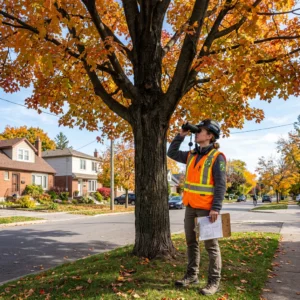
A Level 1 assessment is a walk-by survey conducted across a population of trees, used for post-storm triage, municipal inventory management, or an initial sweep of a large property. The arborist surveys each tree from ground level at walking pace, without close hands-on examination of individual defects. The output is a priority list identifying which trees require a full Level 2 evaluation, rather than a formal risk rating for individual specimens.
Best suited for: Condominium corporations, schools, parks managers, and commercial property owners in Toronto who need to determine — quickly and cost-effectively after a weather event — which trees in a large inventory require urgent attention. A Level 1 survey across a property with 20 or more trees will efficiently direct resources to the specimens that genuinely need deeper examination.
Level 2 — Basic Assessment
A Level 2 assessment is a detailed, tree-by-tree examination of structure, identified defects, target zones, and failure likelihood — this is the standard for individual homeowner situations across Toronto and the GTA. The arborist conducts a thorough walk-around of each tree, examining the root collar and soil zone, the trunk and bark for cracks, cavities, and decay indicators, the scaffold branch architecture, and the canopy for dead wood, dieback, and asymmetry. The written report produced includes a formal ISA risk rating, documented defects with photographs, an identified target zone (what the tree could strike), and a specific management recommendation.
A Level 2 assessment is what most Toronto homeowners require for:
- Permit applications under Chapter 813 where hazard is the basis for removal approval
- Insurance claim support after storm damage or a fallen limb incident
- Pre-construction tree protection plans submitted to the City or a developer’s arborist
- Legal documentation for neighbour-tree liability disputes or property sale disclosures
- Deciding between removal and remediation for a hazardous or structurally compromised tree
Level 3 — Advanced Assessment
A Level 3 assessment adds diagnostic instruments to quantify internal decay, assess root plate stability, and measure the load-bearing capacity of a tree that visual inspection cannot fully characterise. Instruments used in a Level 3 assessment include resistograph (micro-drilling) to map decay columns, sonic tomography to image internal wood density, fractometer testing to assess wood strength, and targeted root excavation to examine root architecture and anchoring. Level 3 is reserved for high-value, high-consequence situations where a visual assessment leaves unacceptable uncertainty.
Level 3 is appropriate in Toronto when:
- A heritage or significant tree’s removal would require extensive regulatory justification and the owner wishes to explore all retention options first
- A Level 2 assessment returned a “High” or “Extreme” rating for a tree directly over an occupied structure, and the data needs to be instrument-backed to withstand legal scrutiny
- A legal dispute requires defensible, peer-reviewable evidence rather than visual professional opinion
- A cabling and bracing intervention is under consideration for a major limb failure risk, and the arborist needs load data to specify the correct cable grade and anchor points
Tree Risk Assessment Cost in Toronto
Tree risk assessment fees in Toronto are quoted individually after a free phone consultation — the cost is not priced as a flat rate because it depends on the assessment level required, the number of trees on the property, site access constraints, and the documentation scope (verbal summary, written report, or full instrument-based technical report with photographs). Call 647-558-1366 for a free, written, itemised quote with no obligation.
If the assessment recommends tree removal as the management action, removal pricing follows a size-based structure:
| Tree Size | Height Range | Typical Removal Cost (CAD) |
|---|---|---|
| Small | Under 30 ft | $300–$500 |
| Medium | 30–50 ft | $500–$900 |
| Large | 50–70 ft | $900–$1,800 |
| Very Large | 70 ft+ | $1,800–$3,500+ |
Stump grinding, if required following removal, is quoted separately: $150–$250 CAD added at the time of removal booking, or $200–$400 CAD as a standalone engagement booked independently. Crane access, where the site or tree size requires it, adds $300–$600 (always disclosed upfront in the written quote before any work begins). All quotes are free, written, and fully itemised with no obligation and no deposit required for standard work.
Tree Risk Assessment vs. Arborist Report
A tree risk assessment and an arborist report are distinct documents with different primary purposes — though both are produced by ISA Certified Arborists and are frequently requested together for the same tree. The detailed comparison is covered at Arborist Report vs. Tree Risk Assessment; here is the summary:
| Feature | Tree Risk Assessment | Arborist Report |
|---|---|---|
| Primary output | Formal ISA risk rating + management recommendation | Written health, structure & condition assessment |
| Required for Chapter 813 permit? | Required when hazard is the permit basis | Required for all Chapter 813 applications |
| Insurance & legal use | Liability claims, neighbour disputes, emergency removal justification | Pre-existing condition documentation; property sales |
| Construction & development | Less common; sometimes bundled with arborist report | Required for City-submitted tree protection plans |
| Emergency availability | Same-day emergency assessment available | Typically 2–5 business days for full written report |
| Who typically commissions it | Homeowners with a hazardous or post-storm tree | Homeowners, developers, lawyers, insurers, real estate agents |
In practice, many Toronto homeowners dealing with a Chapter 813 permit application based on tree hazard will need both the risk assessment (to justify the hazard claim) and the arborist report (to satisfy the permit requirement). Toronto Tree Removal produces both in a single site visit when the situation warrants it, eliminating the cost and delay of scheduling a second arborist.
Tree Risk Assessments Across the GTA
Toronto Tree Removal conducts ISA-standard risk assessments across the full Greater Toronto Area. Each area of the GTA has its own dominant species profile, soil conditions, and bylaw context that influences what kinds of assessments are most commonly needed.
- Scarborough — Large residential lots with mature oaks, silver maples, and cottonwoods bordering ravines; root instability on Toronto’s characteristic clay soils is a frequent Level 2 finding, particularly after wet springs.
- North York — Dense Norway maple populations in tight residential yards; co-dominant stem failure and root zone conflicts with driveways, sidewalks, and underground utilities are the most common assessment triggers.
- Etobicoke — Older post-war neighbourhoods with legacy elms and large silver maples; many specimens fall under Chapter 813 diameter protection, and permit-backed hazard assessments are frequently required before any work can proceed.
- Vaughan and Markham — Active new-construction corridors where retained mature trees frequently need pre-build protection assessments to document condition before excavation begins — and post-build assessments to identify construction-related root damage.
- Mississauga and Brampton — Large canopy trees near Hydro One transmission corridors; Level 2 assessments often include utility-proximity recommendations and coordination requirements before any pruning or removal work can proceed.
- Downtown Toronto — Heritage trees on compact lots where removal requires extensive documentation; Level 3 advanced assessments are more common in these situations, since the regulatory bar for removal justification is higher and the consequence of a wrong decision — either way — is significant.
Why Choose Toronto Tree Removal?
Toronto Tree Removal conducts tree risk assessments with ISA Certified Arborists who hold the IRAT (ISA Risk Assessment Training) credential — the qualification specifically designed for structured tree failure-risk evaluation using the ISA’s standardised methodology. Every assessment is backed by $5,000,000 in general liability insurance, with all crew members covered under WSIB (Workplace Safety and Insurance Board). Certificates of insurance are available on request before work begins.
- 15+ years of GTA fieldwork — deep familiarity with Toronto’s species mix, soil profiles, climate stressors, and municipal bylaw requirements means assessments reflect local context, not generic templates
- Written, itemised reports — every Level 2 and Level 3 assessment produces a formal ISA risk rating, defect documentation with photographs, an identified target zone, and a specific management recommendation your insurer, lawyer, or permit officer can act on
- Chapter 813 permit handling — where removal is the recommended action, we prepare the arborist supporting letter and guide the permit application through the City’s 5–10 business day processing window, including responding to any City queries
- Emergency assessment response — 2-hour response target across the GTA, 24/7 including weekends and statutory holidays, for post-storm or imminent-hazard situations
- Full-service follow-through — if the assessment recommends removal, pruning, or cabling, we execute that work directly with no need to source a second contractor, maintaining continuity between assessment findings and the work performed
- No tree topping — all pruning recommended following an assessment conforms to ISA standards and ANSI A300 guidelines
Frequently Asked Questions
What is a tree risk assessment in Toronto?
A tree risk assessment is an ISA-standard structured evaluation that determines whether a tree poses an unacceptable risk to people or property. A certified arborist identifies defects, estimates failure likelihood, and assigns a formal risk rating — Low, Moderate, High, or Extreme — with a written management recommendation specifying the corrective action and timeline required.
What is IRAT and why does it matter for my assessment?
IRAT stands for ISA Risk Assessment Training — the International Society of Arboriculture’s qualification specifically designed to certify arborists in structured tree failure-risk evaluation. An IRAT-credentialed arborist follows a defined, defensible protocol and produces a documented risk rating rather than an informal visual opinion. Toronto Tree Removal’s lead arborists hold this credential, which means your written report will stand up to insurer, legal, or City scrutiny.
How much does a tree risk assessment cost in Toronto?
Tree risk assessment fees are quoted individually after a free consultation — the cost depends on the level of assessment required (Level 1, 2, or 3), the number of trees on the property, site access, and the documentation scope. Call 647-558-1366 for a free, written, itemised quote with no obligation and no deposit required.
Do I need a permit before removing a high-risk tree in Toronto?
Yes, in most cases. Any tree with a trunk diameter of 30 cm or greater is protected under Toronto Municipal Code Chapter 813. A written risk assessment documenting a “High” or “Extreme” rating provides the legal basis for a hazard-removal permit application and can expedite City approval. Fines for unpermitted removal of a protected tree range from $500 to $100,000 per tree. Toronto Tree Removal handles the permit paperwork, including the required arborist supporting letter; typical processing takes 5–10 business days.
How long does a Level 2 tree risk assessment take?
A Level 2 basic assessment on a single tree typically takes 1–2 hours on-site, plus time for report preparation. A Level 1 walk-by survey over a larger property takes 30–60 minutes depending on tree count. A Level 3 advanced assessment using diagnostic instruments may require a full day, depending on the number of trees assessed and the instrumentation involved.
Will a tree risk assessment help with my insurance claim?
Yes. A written Level 2 or Level 3 risk assessment documenting specific defects, an ISA risk rating, and the recommended management action provides the third-party, credential-backed evidence that insurers require when evaluating storm-damage claims, property liability disputes, and neighbour-tree damage cases. The report is produced by an ISA Certified Arborist and carries documented professional authority.
What is the difference between a tree risk assessment and an arborist report?
A tree risk assessment produces a formal ISA risk rating focused on failure potential and required management action. An arborist report documents overall tree health, structure, and condition — required for Chapter 813 permit applications, construction tree protection plans, and property sales. Many situations require both; Toronto Tree Removal produces them together in a single site visit. Full comparison: Arborist Report vs. Tree Risk Assessment.
Can I get an emergency tree risk assessment?
Yes. Toronto Tree Removal targets a 2-hour response across the GTA for emergency situations — including post-storm assessments where a tree or major limb has partially failed and the risk to the property is immediate. Call 647-558-1366 directly for emergency response; we are available 24/7 including weekends and statutory holidays.
What happens if the assessment says the tree must be removed?
If the risk rating indicates removal is the required management action, Toronto Tree Removal provides the arborist supporting letter for a Chapter 813 permit (where the tree is protected), manages the full permit application, and proceeds to removal once the City grants approval. Removal costs depend on tree size: small trees under 30 ft run $300–$500 CAD; medium trees 30–50 ft run $500–$900 CAD; large trees 50–70 ft run $900–$1,800 CAD; and very large trees over 70 ft run $1,800–$3,500+ CAD. All quotes are free, written, and itemised.
Do you conduct tree risk assessments in Scarborough, Etobicoke, and North York?
Yes. Toronto Tree Removal conducts ISA-standard tree risk assessments across all Toronto neighbourhoods and the full Greater Toronto Area — Scarborough, North York, Etobicoke, Vaughan, Mississauga, Markham, Brampton, Richmond Hill, Aurora, Oakville, Burlington, and the surrounding York, Peel, Durham, and Halton regions. Call 647-558-1366 or visit our contact page to request a quote.
Get Your Free Quote Today
Call: 647-558-1366 — or visit our contact page to book a free, written, no-obligation tree risk assessment quote. ISA Certified Arborists with IRAT credentials, $5,000,000 general liability insurance, WSIB coverage, and 15+ years of GTA experience. Serving Toronto, Scarborough, North York, Etobicoke, Vaughan, Mississauga, Markham, Brampton, and all surrounding GTA communities.