
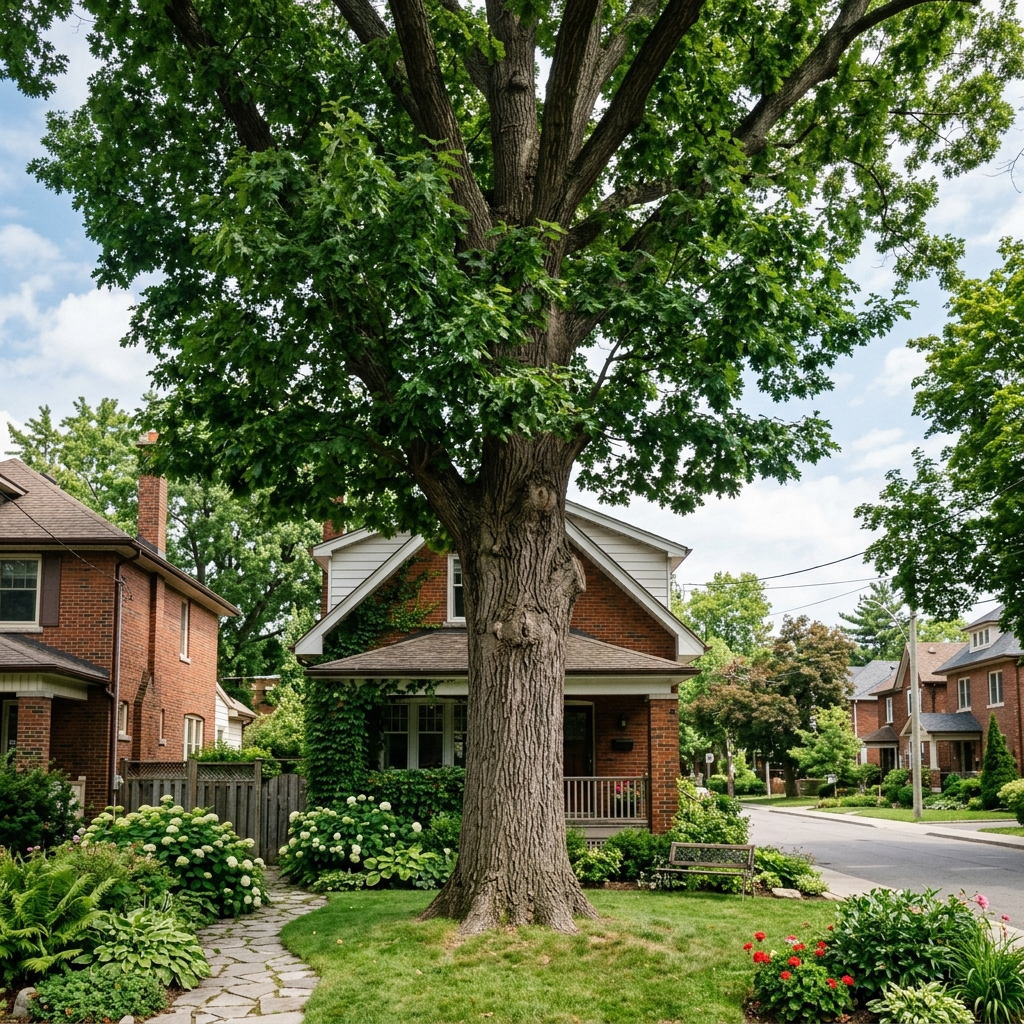
Your tree just fell. Your first instinct: call 311. But here’s what most Toronto homeowners don’t know — 311 will not help if the tree is on your private property. The City of Toronto explicitly will not inspect, assess, or remove private trees, even when they’re fallen, dangerous, or blocking your driveway. For private trees, 311 response time is effectively zero days: they simply don’t come. For city trees, expect 5–30+ business days. A private ISA-certified arborist reaches you in 2 hours. Here’s the full breakdown of when 311 applies (it sometimes does), when it doesn’t (usually), and exactly what each option costs.
This guide is the companion to our 311 vs Private Arborist decision-framework post — this one focuses on response times and costs so you can make the right call in an emergency.
311 vs Private Arborist: Quick Comparison
The fastest way to understand the difference: 311 manages the City’s 600,000+ street and park trees; you are responsible for every tree rooted primarily on your private property. Here is the side-by-side breakdown.
| Factor | Toronto 311 (City) | Private Arborist (TTR) |
|---|---|---|
| Trees Covered | City-owned only — street allowance, parks, boulevards | All trees on your private property |
| Response Time (Non-Emergency) | 5–10 business days (scheduled queue) | Same-day or next-day available |
| Response Time (Emergency) | Up to 3 business days for city hazards; 0 days for private trees | 2-hour dispatch guarantee, 24/7/365 |
| Storm Season Wait | 20–30+ days (queue surges during Aug–Oct) | 2-hour target maintained |
| Cost to Homeowner | $0 for eligible city trees | $800–$3,500 (residential avg.) |
| Permit Handling | City handles its own tree permit | You apply ($262.50 Chapter 813 fee) — or we bundle it |
| Insurance Documentation | Not provided for private claims | ISA-certified report accepted by all major Ontario insurers |
| Service Guarantee | No SLA for private trees (N/A) | ISA-certified, $5M liability, WSIB |
What Toronto 311 Actually Does for Trees
Toronto 311 manages city-owned trees on the public road allowance — the strip of land between the sidewalk and the street curb, plus trees in city parks and on other municipal property. If more than 50% of a tree’s base sits on City property, it’s a city tree and 311 is your first call. If more than 50% sits on your lot, it is your responsibility and 311 will not assist.
Toronto manages over 600,000 street trees. When you call 311 about a tree, the City’s Urban Forestry division will:
- Assess whether the tree is on city or private property
- Schedule an inspection (non-emergency: 5–10 business days)
- Queue removal or pruning work based on hazard rating
- Handle any required permits for their own tree work
What 311 will not do, per the City’s own storm guidance: “The City will not inspect private trees damaged by a storm. Maintenance of privately owned trees is the responsibility of the property owner.” This is not a policy gap — it is a hard jurisdictional rule. No amount of calling 311 will change it for a private tree.
For a deeper explanation of 311’s full scope, see our Toronto 311 tree services complete guide.
Response Time: 311 (5–30+ Days) vs Private Arborist (2 Hours)
For private trees, 311 response time is zero — they do not respond. For city trees, the realistic wait times are significantly longer than most homeowners expect.
311 city-tree response timeline:
- Non-emergency inspection: 5–10 business days to schedule an assessment
- Non-emergency removal: After assessment, crews are typically booked several weeks out
- Emergency city hazard (limb over road, leaning street tree): Up to 3 business days by City standard — not hours
- Storm season (August–October): Queues extend to 20–30+ business days as Urban Forestry handles hundreds of simultaneous reports across the city
Private arborist (TTR) response timeline:
- Emergency dispatch: 2-hour target, 24 hours a day, 7 days a week, 365 days a year
- Scheduled removal: 1–3 business days for non-urgent private trees
- Storm season: Emergency guarantee maintained — we staff up during peak season
During the August–October storm window — when fallen trees peak across Scarborough, North York, Etobicoke, and Mississauga — waiting 20–30 days for a city response while a tree sits on your driveway or fence is not realistic. If it is on your property, you need a private arborist. Call TTR: 647-558-1366 — 24/7 emergency dispatch.
See our full 2-hour emergency tree removal guarantee for what to expect on an emergency call.
Cost Breakdown: 311 (Free for City Trees) vs Private Removal ($300–$3,500+)
311 costs you nothing for eligible city trees — the work is taxpayer-funded through Urban Forestry’s budget. Private removal on your property is your expense. Here is what to budget.
| Service | Who Pays | Typical Cost (CAD) | Notes |
|---|---|---|---|
| City tree removal (311) | City of Toronto (taxpayer) | $0 to homeowner | 5–30+ day wait; city’s schedule, not yours |
| Private tree removal — small (<20 ft) | Homeowner | $800–$1,200 | Includes cut, debris haul; stump extra |
| Private tree removal — medium (20–50 ft) | Homeowner | $1,200–$2,200 | Most residential maples, oaks, ashes |
| Private tree removal — large (50–80 ft) | Homeowner | $2,200–$3,500 | Large silver maples, poplars, elms |
| Chapter 813 permit application | Homeowner | $262.50 (City fee) | Required for protected trees ≥30 cm DBH |
| Arborist report (if separate) | Homeowner | $325–$750 | Often bundled — ask when getting quote |
| Stump grinding (add-on) | Homeowner | $150–$600 | Bundle same-day saves $50–$200 |
| Emergency / after-hours premium | Homeowner | +$200–$500 | 2 AM callout, same-day emergency |
Cost tip: Bundle stump grinding with removal on the same day — our crew and equipment are already on site, and you pay $150–$250 instead of $200–$400 for a separate visit. For detailed pricing by tree size and GTA neighbourhood, see our Toronto tree removal cost guide.
311 Decision Tree: Does 311 Cover Your Tree?
Before calling 311, run through this decision logic to save time. If 311 does not cover your situation, skip to calling a private arborist immediately — every hour a fallen tree blocks access or contacts a power line increases risk and cost.
- Is the tree on City property? (street allowance/boulevard between sidewalk and curb, park, ravine designated city land) → Yes: Call 311 (free, but 5–30 day wait). No/Unsure: Go to step 2.
- Not sure if city or private? Call 311 — they will confirm ownership at no cost. If confirmed private, proceed to step 3.
- Is it an emergency? (blocking access, touching power lines, structural danger to home) → Yes: Call a private arborist NOW — 2-hour response, 647-558-1366. No: Get a free quote and schedule within 1–2 weeks ($800–$3,500 depending on size and complexity).
- Is the tree in a ravine? Toronto’s Ravine and Natural Feature Protection By-law applies. All tree work — city or private — requires City approval regardless of trunk diameter. Call us first for permitting guidance before touching anything.
Scenario 1: Tree Fell on Your Private Property
If a tree falls on your private property — your driveway, backyard, roof, or fence between lots — 311 will not respond, and you need a private arborist immediately.
Real-world example: A 60-foot silver maple came down across a Scarborough driveway at 1:45 AM during an August storm, blocking both vehicles and the side entry. The homeowner called 311 first — the automated system confirmed it was a private-property issue and provided no assistance. TTR was called at 2:00 AM, crew was on-site at 3:55 AM, and the driveway was fully cleared by 8:15 AM. Total cost: $2,200, including after-hours emergency premium. The homeowner filed the arborist’s report with TD Insurance the next morning and received a partial reimbursement for the portion that struck and damaged the fence.
Key fact: Do not move the fallen tree before your insurance adjuster approves — photographs of the tree in position are required for most storm-damage claims. Our crew will hold until you’ve documented or can instruct us to proceed.
Scenario 2: City Tree Fell — But Damaged Your Property
If a city-owned boulevard tree falls and damages your fence, roof, or car, the cleanup responsibility is split: 311 handles the city’s tree, but damage to your property is a separate matter involving your insurer and potentially a claim against the City.
What to do: Call 311 to report the city tree — they will schedule removal of the city’s portion. Simultaneously, call your home insurer within 48 hours and document all damage with photos before any debris is moved. If you want to pursue the City for the damage their tree caused, file through the City’s Claims Department (a separate process from 311). A private arborist report documenting the origin and condition of the tree — including signs of prior decay that the City should have caught — strengthens a damage claim against the City. That report runs $325–$750 but can be critical if the City disputes liability.
Scenario 3: Dangerous or Hazardous Tree on Your Lot
A dead or structurally compromised tree on your property requires removal regardless of whether an emergency has occurred yet — and there is a permitting shortcut available for certified hazards.
Under Toronto Municipal Code Chapter 813, protected trees (≥30 cm DBH) normally require a permit and a $262.50 application fee. However, if an ISA-certified arborist documents the tree as an imminent hazard, the Chapter 813 imminent-hazard exemption applies: no permit is required before removal, and we file the documentation with the City on your behalf after the work is completed.
Real-world example: A dead Norway maple in a North York backyard was showing major crown dieback and a visible crack at the trunk base. Assessment fee: $350. Removal: $1,400. Total: $1,750. Chapter 813 imminent-hazard exemption applied — no permit delay, work completed in one day. The alternative (standard permit route) would have added 5–10 business days and the $262.50 fee for a tree the arborist considered an active falling risk.
Scenario 4: Storm Damage — Emergency vs Scheduled
Post-storm triage determines whether you call for emergency dispatch or can schedule within a few days. The deciding factors are: immediate access blockage, power line contact, and structural risk to buildings.
| Situation | Call Type | Who to Call | Typical Cost |
|---|---|---|---|
| Tree blocking driveway or road | Emergency | TTR — 2-hour response | $1,200–$2,500 + emergency premium |
| Branch touching power line | Emergency — Hydro first | Toronto Hydro (416-542-8000), then TTR | $800–$1,500 after Hydro clears |
| Tree leaning against house | Emergency | TTR — 2-hour response | $1,500–$3,500 |
| Large branch down in yard (no access block) | Scheduled (1–2 days) | TTR — same or next-day booking | $600–$1,200 |
| City boulevard tree down | Scheduled | 311 (but 20–30 day wait in storm season) | $0 to homeowner |
| Dead tree — no immediate emergency | Scheduled | TTR — within 1 week | $800–$2,200 |
Power-line rule: Never attempt to remove a branch touching a live wire yourself. Call Toronto Hydro at 416-542-8000 first. Once they confirm the line is de-energized or cleared, we can proceed with tree removal safely. This sequence — Hydro first, arborist second — protects you, our crew, and your neighbours.
Why Private Arborist Beats 311 for Private Trees
For private trees, 311 is not an option — it is a non-starter. But even where you might think 311 could help (nearby city trees, general tree questions), a private arborist delivers capabilities 311 simply does not offer.
TTR credentials that matter for homeowners:
- ISA Certified Arborist — internationally recognized credential, required for Chapter 813 imminent-hazard exemptions and accepted by all major Ontario insurers
- $5M liability insurance — covers your property during all work; 311 crews are covered separately under City insurance (and won’t be on your private property anyway)
- WSIB clearance — protects you from potential workplace liability claims if a worker is injured on your property
- TCIA member — Tree Care Industry Association standards compliance
- 15+ years of GTA experience — Scarborough, North York, Etobicoke, Vaughan, Mississauga, Markham, Brampton
- 2-hour emergency response target — hard commitment, not a marketing estimate
“Our silver maple came down at 3 AM during a storm and landed on the fence between our lot and our neighbour’s property in Etobicoke. I called 311 first — they told me it was a private property issue and couldn’t help. Called Toronto Tree Removal at 3:20 AM. Crew arrived by 5:10 AM. By 8:30 AM the tree was gone, the fence was documented for the insurance claim, and both neighbours were happy. Total cost was $2,450, and insurance covered $1,800 of it with the arborist report they provided.”
Insurance Claims: 311 vs Private Arborist Reporting
For insurance purposes, a private ISA-certified arborist report is the document Ontario insurers require. 311 does not generate reports usable for private property claims.
If a tree falls and damages your home or structures:
- Call your insurer within 48 hours — TD, Intact, Aviva, BelairDirect, Economical all accept ISA-certified arborist reports
- Do NOT move or cut debris until your adjuster approves or explicitly waives inspection (get this in writing or by email)
- Photograph everything: tree position, impact point, existing damage, any visible pre-existing decay on the tree
- Request an arborist report from TTR — we document origin, condition at time of fall, and whether the event was foreseeable (affects claim outcome)
- If a city tree caused the damage, file separately against the City’s Claims Department after your own insurer pays — the City’s process is slower and may require evidence of prior negligence
Neighbour liability: If a tree rooted on your property falls onto your neighbour’s property, that neighbour’s insurer may pursue liability against you — particularly if the tree showed visible signs of disease or decay you could reasonably have known about. An ISA arborist report documenting tree condition prior to failure (from an annual inspection, for example) can defend against these claims. See our detailed tree removal insurance claim walkthrough for step-by-step guidance.
FAQ: Toronto 311 vs Private Arborist
What if I’m not sure whether the tree is on City or private property?
Call 311 — confirming tree ownership is a service they provide for free and it doesn’t commit you to anything. They will tell you whether Urban Forestry is responsible. If it turns out to be private property, you’ll have your answer in one call and can immediately contact a private arborist.
Does 311 ever remove trees on private property?
No — never. The City of Toronto explicitly does not inspect, assess, or remove privately owned trees under any circumstances, including storm damage. This is a hard jurisdictional rule under Toronto’s Urban Forestry policy. If the tree is on your property, private removal is your only option.
What’s the fastest way to get a tree removed from my private property in Toronto?
Call an ISA-certified private arborist with a 24/7 emergency line. TTR guarantees 2-hour emergency dispatch, 24/7, at 647-558-1366. This is the only option for private trees — 311 does not respond to private property tree issues at any speed.
Will my home insurance cover private tree removal in Toronto?
Insurance typically covers tree removal costs when the tree has damaged an insured structure (roof, fence, garage, home). Standard removal of a healthy or dead tree without damage is generally not covered. To maximize claim success, engage an ISA-certified arborist immediately — their report is the documentation Ontario insurers (TD, Intact, Aviva, BelairDirect, Economical) require. 311 does not produce private-property insurance documentation.
Can I remove a tree on my private property myself to save money?
No — not for protected trees. Toronto’s Chapter 813 prohibits removal of trees ≥30 cm DBH (about 12 inches trunk diameter) on private property without a permit or an ISA-certified imminent-hazard exemption. DIY removal without proper authorization risks fines from $500 to $100,000 under the Municipal Code. Smaller trees (<30 cm DBH) are generally unrestricted, but DIY removal carries significant safety risks without proper equipment and training.
How long does 311 take to respond to a fallen tree on a city street?
For non-emergency city trees, 311 typically schedules an inspection within 5–10 business days, with crew work scheduled after that. During storm season (August–October), queues regularly extend to 20–30+ business days. For city-tree emergencies (imminent road hazard), the City’s standard is up to 3 business days — still not same-day. For private property trees at any urgency level: 311 response time is zero because they don’t respond to private trees.
Does 311 handle trees in a ravine on my property?
No — if your property includes ravine land, Toronto’s Ravine and Natural Feature Protection By-law applies regardless of whether the land is technically private. All tree work in ravine-designated areas requires City approval, no matter the tree size. Call us before touching anything in a ravine — we handle the permitting process, which differs significantly from standard Chapter 813 removal.
How do I know if my tree qualifies for the Chapter 813 imminent-hazard exemption (no permit required)?
The exemption requires written documentation from an ISA-certified arborist confirming the tree poses an imminent risk of failure. TTR provides this assessment — if our arborist confirms imminent hazard, we can remove the tree immediately without waiting for a permit, and we file the Chapter 813 exemption documentation with the City post-removal. Call 647-558-1366 for a same-day assessment. For full permit rules, see our Chapter 813 complete guide.
What if a neighbour’s private tree is threatening my property — can 311 force them to act?
311 does not have authority over disputes between private property owners. If a neighbour’s tree poses a risk to your property, your options are: (1) notify your neighbour in writing with an ISA arborist’s risk assessment, (2) consult a property lawyer if the neighbour refuses to act, or (3) remove branches that cross your property line at your own expense (you cannot remove the whole tree). TTR can provide the written hazard assessment needed for neighbour notification or legal action.
Is the 311 report useful at all if a city tree damaged my fence?
A 311 service report confirms the City was notified, which is useful as a timestamp for a claim against the City. However, it does not constitute an arborist report and is not accepted as damage documentation by private insurers. For your own insurance claim, you still need an ISA-certified arborist report. For a City liability claim (suing the City for failing to maintain a street tree), the 311 report combined with evidence of prior-known decay is the starting point — a private arborist’s condition assessment strengthens the case significantly.
Get Your Free Quote Today
Toronto Tree Removal — ISA Certified, $5M Liability, WSIB Cleared, 15+ Years, 2-Hour Emergency Response Target. Serving Toronto, Scarborough, North York, Etobicoke, Vaughan, Mississauga, Markham, and Brampton.
Call: 647-558-1366