What’s the difference?
Toronto homeowners in 2026 face a critical decision when a tree on their property shows signs of distress, disease, or structural weakness: should they commission an arborist report or a tree risk assessment? These documents sound similar, but they serve fundamentally different purposes and carry different costs, timelines, and legal weight. An arborist report is a broad diagnostic tool—a certified professional examines the tree’s health, species identification, condition history, and recommended care or removal justification. A tree risk assessment is narrower and more urgent: it quantifies the likelihood and severity of failure (branch drop, uprooting, limb strike) and assigns a risk rating that often triggers insurance claims, municipal permits, or liability decisions. Both require qualified professionals, but the stakes, depth of analysis, and downstream consequences differ sharply. In Toronto’s dense neighborhoods, where mature trees overhang properties, fences, and driveways, choosing the wrong tool can leave you unprotected legally, uninsured financially, or delayed unnecessarily in making a removal or preservation decision. This guide breaks down the real-world scenarios where each document matters, what they cost in 2026 CAD dollars, and how Toronto bylaws and insurance expectations shape your choice.
Side-by-side comparison
| Scenario | Arborist Report | Tree Risk Assessment |
|---|---|---|
| Typical Cost Range (CAD) | $350–$650 per tree | $500–$1,200 per tree |
| Timeline | 7–14 days (report generation) | 3–7 days (urgent focus) |
| Permit Required | No (diagnostic only) | Yes, if removal is recommended (Toronto bylaw compliance) |
| When to Choose | Health concern, pruning options, species ID, long-term management plan, no immediate danger suspected | Visible damage, recent storm, branch already fallen, tree over home/driveway, insurance claim pending |
| Risk if You Choose Wrong | Choose this for urgent risk = delayed action, potential liability if tree fails before assessment | Choose this for minor health issue = unnecessary cost, false alarm classification, wasted professional time |
| Insurance Recognition | Supportive but not required by most policies | Often required to validate damage claim or justify preventive removal |
Arborist report — when it’s the right call
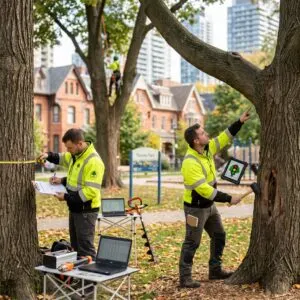
Choose an arborist report when you suspect a health or structural issue but see no imminent danger. Your oak has yellowing leaves mid-summer, or a maple’s crown has thinned in recent years—these are diagnostic questions, not emergency situations. An arborist report provides a detailed examination of the tree’s age, species characteristics, soil conditions, disease history, and growth patterns. The report recommends care strategies: targeted pruning, pest management, cabling for weak crotches, or gradual decline monitoring. For Toronto homeowners planning long-term landscape management or seeking to preserve heritage or mature specimens, an arborist report is the foundation. It also protects you legally if a neighbor or municipality questions why a seemingly healthy tree remains. The report documents why removal isn’t justified yet. Costs range $350–$650 CAD per tree, and the professional will spend 1–2 hours on-site, climbing if necessary, taking increment core samples or resistograph readings, and photographing condition. Timeline is relaxed: 7–14 days for a written report. Arborist reports shine when you need a second opinion before hiring a tree removal or pruning service, or when dealing with heritage trees regulated under Toronto’s Municipal Code Chapter 349 (Private Tree By-law). They’re also invaluable for estate planning, property sales disclosure, or homeowner insurance applications where you need to demonstrate due diligence.
Tree risk assessment — when it’s the right call
Choose a tree risk assessment when urgency is present: a branch is cracked or partially hanging, the tree has visible cavities and lean, a recent storm damaged major limbs, or the tree stands over your house, garage, or a neighbor’s property. Risk assessments assign numerical or categorical ratings (low, moderate, high, extreme) based on probability of failure multiplied by consequence (what or who it could hit). A tree risk assessment is the document that insurers, municipal inspectors, and liability adjusters expect when a claim or permit application involves a tree with known defects. In Toronto, where mature oaks and maples lean toward neighboring properties or power lines, this assessment triggers concrete action: removal permits, preventive pruning, or emergency takedown. Costs run $500–$1,200 CAD per tree because the certified arborist must incorporate failure mode analysis, environmental stressors, and liability calculations. Turnaround is fast—3–7 days—because the assessment prioritizes risk quantification over long-term health strategy. If your insurer requests documentation before covering storm damage, a tree risk assessment is non-negotiable. If a city inspector cites a hazard tree, you’ll need this report to justify removal and obtain permits. For storm damage cleanup or hazard tree removal, a risk assessment is the credential that legitimizes the work and protects your liability exposure.
Edge cases and Toronto-specific factors
Toronto’s bylaw environment shapes the choice sharply. The Private Tree By-law (Chapter 349) protects trees 20 cm diameter or larger on private property; removal without a permit carries fines up to $50,000. An arborist report alone does not satisfy permit requirements—the city demands a certified report demonstrating hazard or justified removal reason. However, a tree risk assessment with “high” or “extreme” rating usually fast-tracks permits. Conversely, an arborist report showing stable health can justify a permit denial or tree retention. For disease-affected trees, the bylaws require proof of unrecoverable decline; an arborist report documenting disease progression strengthens your position. Insurance companies behave differently: some demand a tree risk assessment before reimbursing removal costs, while others accept an arborist report plus photographs. Check your homeowner policy language or call your broker before spending $800+ on the wrong document type. Neighborhood dynamics matter too. If a tree poses risk to a neighbor’s property, your insurer or their insurer may demand both reports—one to justify removal, one to quantify liability exposure. In densely treed neighborhoods like Rosedale, Annex, or Leslieville, where mature trees overhang multiple properties, getting the assessment type right avoids legal delays and protects you from claims.
Frequently asked questions
Can one professional do both an arborist report and a tree risk assessment at the same time?
Yes. Many certified arborists offer bundled reports that include health diagnosis and risk quantification. This typically costs $600–$1,000 CAD per tree and saves time, but confirm the final document explicitly addresses both health and risk rating—some professionals only emphasize one.
Does Toronto require a certified arborist, or can any tree service write a report?
For permit applications and insurance claims, Toronto and most insurers require credentials from the International Society of Arboriculture (ISA Certified Arborist) or the Tree Care Industry Association (TCIA). An uncertified report may delay permits or invalidate insurance claims.
What if my tree failed after I got a clean arborist report?
A professional arborist report documenting no hazard protects you from negligence liability in most cases, provided the professional was certified and followed industry standards (ANSI A300). Your homeowner insurance may still cover damage, but disputes are rare if documentation is solid.
Can I use a tree risk assessment to justify removal for aesthetics or shade reduction?
No. A risk assessment is strictly a safety and failure-probability tool. If your motive is aesthetics, you need an arborist report documenting health decline, disease, or structural limits to justify permit approval under Toronto bylaw.
How long are arborist reports and tree risk assessments valid for permits and insurance?
Most reports are valid for 12–24 months, depending on the issue and your jurisdiction. Rapidly changing conditions (progressive disease, severe lean after a storm) may shorten validity; check with your permit office or insurer for specific requirements.
Do I need both reports, or is one enough?
For most Toronto homeowners, one document suffices if chosen correctly. An arborist report covers routine maintenance and preservation decisions; a risk assessment covers urgent or insurable hazards. Only high-stakes scenarios (tree over home with disease, neighbor dispute) warrant both.
Bottom line
Choose an arborist report if: the tree shows health concerns (yellowing, thinning, pest activity) but no visible structural damage; you’re planning long-term care and preservation; you’re preparing for a property sale or heritage designation; or you need to justify keeping a mature tree. Cost is lower ($350–$650), timeline is flexible (7–14 days), and the focus is diagnostic and advisory.
Choose a tree risk assessment if: the tree has visible damage (cracks, cavities, severe lean); you suspect imminent failure; a storm has already impacted it; the tree overhangs your home, driveway, or power lines; an insurer demands it; or you need to apply for a removal permit under Toronto bylaw. Cost is higher ($500–$1,200), timeline is urgent (3–7 days), and the focus is liability and failure probability.
In practice, many Toronto homeowners benefit from a bundled assessment covering both health and risk, especially for mature trees in high-consequence locations. Start by clarifying what your insurer expects and whether Toronto permits are required. Then contact a certified ISA arborist who understands Toronto’s bylaw environment and can recommend the right tool for your situation. For a free quote and professional assessment of your tree’s needs, visit torontotreeremoval.ninja and describe your situation—our arborists will advise whether you need a health-focused report, a risk-focused assessment, or both.