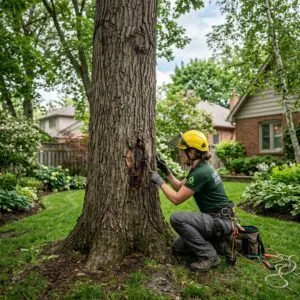
An ISA Certified Arborist differs from a regular tree service in one critical way: they hold a credential from the International Society of Arboriculture (ISA) that requires 3+ years of field experience, a rigorous written exam, and ongoing continuing education — while a regular tree service company may employ no certified staff at all. For routine dead-tree removal, a regular tree service is usually sufficient and costs $1,200–$1,800 CAD. For disease diagnosis, insurance claims, hazardous-tree risk assessments, or Toronto permit applications, an ISA Certified Arborist is required — and often saves you far more than the $400–$1,000 CAD premium.
ISA Certified Arborist vs Regular Tree Service: What’s the Real Difference?
The real difference between an ISA Certified Arborist and a regular tree service is training depth and legal credibility: ISA certification validates expertise in tree biology, disease identification, risk assessment, and safe work practices — credentials that insurance companies, courts, and the City of Toronto recognize and rely on. A regular tree service can cut down, trim, and grind stumps competently, but cannot legally sign an arborist report accepted by Toronto Urban Forestry or provide a certified risk assessment recognized by your insurer.
Here’s why it matters for GTA homeowners: Toronto’s Municipal Code Chapter 813 protects trees with a trunk diameter of 30 cm or more (measured at 1.4 m above grade). Removing a protected tree — or having it removed by someone without proper credentials — can result in fines of $500 to $100,000 CAD. When a permit application requires an arborist report, only an ISA Certified Arborist’s report carries the weight the City expects.
For a side-by-side breakdown of service types and when you need each, see our Toronto Tree Removal FAQ Guide.
What Is an ISA Certified Arborist?
An ISA Certified Arborist is a tree-care professional who has passed the International Society of Arboriculture certification exam — a credential that covers tree biology, soil science, disease diagnosis, safe pruning standards (ANSI A300), risk assessment, and emergency tree-care protocols. To qualify, candidates must document a minimum of three years of full-time, hands-on tree-care experience before they can sit the exam.
Key facts about ISA certification:
- Exam scope: 200+ questions covering tree identification, pruning biology, root systems, soil composition, disease and pest management, cabling and bracing, and worker safety.
- Renewal cycle: ISA Certified Arborists must earn 30 continuing education units (CEUs) every three years to maintain the credential — meaning their knowledge stays current with evolving best practices.
- Verification: Every ISA Certified Arborist has a unique credential number that can be verified in real-time at isa-arbor.com/findanarborist.
- ISA Board Certified Master Arborist (BCMA): A higher-tier credential for arborists with deep specialization — relevant for expert-witness testimony and complex institutional tree management.
In the GTA, ISA certification is recognized across all municipalities: Toronto, North York, Scarborough, Etobicoke, Vaughan, Markham, Mississauga, and Brampton all accept ISA Certified Arborist reports for permit and compliance purposes.
Toronto Tree Removal’s on-staff arborists are ISA Certified, TCIA members, carry $5M liability insurance, and hold WSIB clearance — all verifiable before you sign anything. Learn more about our ISA certification credentials.
What Is a Regular Tree Service?
A regular tree service is a licensed contractor or company that provides tree removal, trimming, pruning, and stump grinding — but may employ no ISA Certified Arborists on staff. Licensing requirements for tree services vary significantly across GTA municipalities: some require only a business licence, while others impose additional insurance and safety requirements. “Certified” in the company name does not mean ISA certification.
Regular tree services are skilled at the mechanical work of tree removal and care. What they typically cannot do:
- Sign an arborist report for a Toronto tree permit application
- Provide a certified risk assessment recognized by insurers for storm-damage claims
- Diagnose tree disease with the authority needed for insurance reimbursement or neighbour-dispute proceedings
- Provide court-recognized expert-witness testimony on tree condition
- Write a Tree Protection Plan accepted by City of Toronto Urban Forestry
A regular tree service quoting you $1,200 for a dead pine removal may be perfectly competent for that job. The problem arises when homeowners assume “any tree company” can handle situations that legally or practically require ISA credentials.
Key Differences: Certified vs Non-Certified
The table below summarises the core differences between an ISA Certified Arborist and a regular tree service across the factors that matter most to GTA homeowners:
| Factor | ISA Certified Arborist | Regular Tree Service |
|---|---|---|
| Training requirement | 3+ years experience + ISA exam + ongoing CEUs | Variable; no mandatory certification |
| Credential verification | ISA directory (verifiable online) | Business licence only (not publicly verifiable) |
| Arborist reports (insurance/permit) | ✅ Yes — legally recognized | ❌ No — not accepted by City or insurers |
| Disease diagnosis accuracy | Trained in pathology; exam-validated | Varies widely; often estimated |
| Risk assessment (hazardous tree) | Formal ISA TRAQ methodology | Visual inspection only; no formal framework |
| Insurance claim support | ✅ Certified report accepted by insurers | ❌ Estimate may be rejected |
| Toronto Chapter 813 permit reports | ✅ Accepted by Urban Forestry | ❌ Not accepted |
| Routine removal (dead/fallen tree) | ✅ Can do | ✅ Can do |
| Stump grinding | ✅ Can do | ✅ Can do |
| Typical cost premium | +30–50% for assessment/report services | Baseline pricing |
Cost Comparison: ISA Certified vs Regular Tree Service in the GTA
Hiring an ISA Certified Arborist costs 30–50% more than a regular tree service for assessment and report work — but for routine removals, the price difference is often minimal. Here’s a scenario-by-scenario breakdown of what GTA homeowners should expect to pay in 2026 CAD:
Cost by Scenario
| Scenario | Regular Tree Service | ISA Certified Arborist | Certification Required? |
|---|---|---|---|
| Routine removal of dead pine (small, accessible) | $1,200–$1,800 | $1,200–$1,800 (no premium for removal only) | No |
| Insurance claim — storm-damaged oak | Removal estimate only ($2,000–$3,000) — insurer may reject | Certified report $500–$1,000 + removal $2,000–$3,000 | Yes |
| Disease diagnosis — unknown tree condition | “Looks like a fungus” (free but unreliable) | Certified assessment $400–$600 | Yes |
| Hazardous tree near house — formal risk assessment | Visual estimate only; no liability coverage | ISA TRAQ risk assessment $600–$1,000 | Yes |
| Toronto permit application (protected tree ≥30cm DBH) | Cannot provide required arborist report | Arborist report $500–$800 | Yes |
| Stump grinding only | $150–$400 per stump | $150–$400 per stump (no premium) | No |
Cost by Tree Size (Routine Removal — GTA Average)
| Tree Size | Regular Tree Service | ISA Certified (removal + basic assessment) |
|---|---|---|
| Small (<20 ft / <20cm DBH) | $600–$1,200 | $600–$1,200 |
| Medium (20–40 ft / 20–40cm DBH) | $1,200–$2,500 | $1,400–$2,800 |
| Large (40–60 ft / 40–60cm DBH) | $2,500–$5,000 | $2,800–$5,500 |
| Extra-large (>60 ft / >60cm DBH) | $5,000–$10,000+ | $5,500–$11,000+ |
Key insight: For simple removals, the certified premium is minimal. For anything involving reports, insurance, permits, or disease, the certified arborist fee often recovers itself through insurer reimbursement or avoided fines. See our complete Toronto tree removal cost guide for a full pricing breakdown.
When Do You NEED an ISA Certified Arborist?
You need an ISA Certified Arborist — not just a tree service — in any of the following situations. This is a decision tree GTA homeowners can use to determine the right hire:
- Is there a legal or permit requirement? → YES: You need a certified arborist. Toronto Chapter 813 requires an arborist report for removal of protected trees (≥30cm DBH). Oak, elm, and ash species often require additional documentation.
- Is the tree diseased or its condition unknown? → YES: Get a certified arborist assessment ($400–$600). Guessing on disease type affects treatment cost, timing, and neighbour liability.
- Is this an insurance claim post-storm? → YES: Your insurer expects an ISA Certified Arborist report. Without it, your claim may be partially or fully rejected. The $500–$1,000 report cost is typically reimbursable.
- Is the tree hazardous — near a structure, power line, or public area? → YES: A certified ISA TRAQ risk assessment ($600–$1,000) establishes the formal risk level and protects you from liability. See our hazardous tree removal service.
- Is there a property line dispute or neighbour conflict about the tree? → YES: Only an ISA Certified Arborist can provide court-recognized expert-witness testimony.
- Are you a post-purchase buyer with tree concerns on a recently acquired property? → YES: A certified tree condition assessment protects you from inheriting liability for a tree the previous owner neglected.
If you answered YES to any of the above: call an ISA Certified Arborist before you book any removal or treatment work. For Toronto and GTA jobs, call Toronto Tree Removal at 647-558-1366 — our ISA Certified Arborists respond within 2 hours for hazardous assessments.
When Is a Regular Tree Service Enough?
A regular tree service is sufficient — and the more cost-effective choice — for straightforward mechanical tree work where no reports, diagnoses, or legal credentials are required. Specifically, you can safely hire a non-certified tree service for:
- Routine removal of a clearly dead, already-fallen, or obviously hazard-free tree where no permit is required (tree DBH under 30cm in Toronto)
- Scheduled trimming and crown maintenance on healthy, non-protected trees where you want no formal assessment
- Stump grinding only — a purely mechanical service that requires no arboricultural knowledge
- Lot clearing on non-protected species where municipal bylaw exemptions apply
- Emergency debris removal after a storm where the tree is already down and no insurance claim is involved
DIY vs Professional Tree Service — Quick Reference
| Task | DIY | Regular Tree Service | ISA Certified Arborist |
|---|---|---|---|
| Pruning small limbs (<2 inch diameter, <10 ft height) | ✅ OK with proper tools | ✅ | ✅ |
| Removing a small dead shrub or sapling | ✅ OK | ✅ | ✅ (overkill) |
| Removing a tree over 20 ft tall | ❌ High risk | ✅ | ✅ |
| Protected tree removal (≥30cm DBH, Toronto) | ❌ Illegal without permit | ❌ Cannot provide report | ✅ Required |
| Disease identification | ❌ Unreliable | ❌ Not exam-validated | ✅ Required |
| Insurance claim support | ❌ | ❌ Usually rejected | ✅ Required |
| Stump grinding | ❌ Requires specialized equipment | ✅ | ✅ |
Insurance & Liability: Certified vs Non-Certified
Insurance companies in Canada trust ISA Certified Arborist reports because the credential signals exam-validated expertise — making certified arborist reports the standard for storm-damage claims, pre-purchase assessments, and neighbour-dispute resolutions. A regular tree service estimate submitted to your insurer may be rejected outright or result in a significantly reduced payout.
Here’s how certification affects insurance outcomes for GTA homeowners:
- Storm damage claims (e.g., TD Insurance, Intact, Aviva): Your insurer will typically require a written arborist opinion on whether the tree damage was caused by the storm event vs pre-existing decay. Only an ISA Certified Arborist report carries the evidentiary weight to satisfy this requirement. A certified report costs $500–$1,000 CAD but is typically reimbursable as part of the claim.
- Pre-existing decay disputes: If an insurer suspects the tree showed signs of disease before the storm, they may deny the claim. An ISA Certified Arborist assessment documenting the tree’s pre-storm condition strengthens your appeal.
- Neighbour-liability tree falls: If your neighbour’s tree fell on your property (or vice versa), an ISA Certified Arborist’s written report on the tree’s condition becomes critical evidence for any liability proceeding — in or out of court.
- Contractor liability: Toronto Tree Removal carries $5M commercial liability insurance and WSIB clearance. A non-certified tree service that causes property damage during removal may carry insufficient coverage. Always verify before signing.
For a full breakdown of what’s covered, see our arborist reports service page.
How to Verify ISA Certification
Verify ISA certification before hiring any arborist by checking the ISA’s public directory at isa-arbor.com/findanarborist — search by name or credential number, and confirm the certification status shows “active” rather than “expired.” This takes two minutes and protects you from fraudulent credential claims.
Full verification checklist for GTA homeowners:
- ISA directory check: Go to isa-arbor.com, search the arborist’s name or credential number. Confirm status = Active, and note the expiry date for renewal confirmation.
- Ask for ISA credential number in writing: Any legitimate ISA Certified Arborist will provide this without hesitation. If they stall, that’s a red flag.
- TCIA membership: Tree Care Industry Association membership is a secondary indicator of professional standards. Not required, but a positive signal.
- WSIB clearance letter: Required in Ontario. Any legitimate tree service should provide a WSIB clearance certificate dated within 90 days. Without it, you could be liable for worker injuries on your property.
- Proof of $5M+ liability insurance: Standard for professional GTA tree services. Under-insured contractors put your property at risk.
- References from insurance claims: Ask specifically for references where the arborist supported a homeowner’s insurance claim — this tests whether their report-writing meets real-world insurer standards.
GTA Neighbourhood Breakdown: Where Certification Matters Most
ISA certification requirements and bylaw complexity vary across the GTA. Here’s what homeowners in different areas need to know:
| Area | Key Certification Requirement | Typical Scenario |
|---|---|---|
| Toronto (all wards) | Arborist report required for protected trees (≥30cm DBH) under Chapter 813 | Oak, elm, ash removal; post-storm insurance claims |
| North York | High density of mature maples and oaks; Chapter 813 applies | Silver maple assessments; insurance claims after ice storms |
| Scarborough | Ravine and river valley setbacks trigger additional environmental review | Ravine-adjacent removals; pre-construction tree assessments |
| Etobicoke | Chapter 813 + Mimico Creek corridor setbacks | Waterfront and creek-adjacent hazardous tree removals |
| Markham | Region of York Tree Bylaw; separate from City of Toronto rules | New-build lot clearing with mature trees |
| Vaughan | City of Vaughan Tree Bylaw; private trees >20cm DBH may be protected | Estate lot clearings; pool/garage additions |
| Mississauga | City of Mississauga Tree Bylaw; woodlot regulations add complexity | Woodlot-adjacent removals; commercial property pruning |
| Brampton | Peel Region forestry rules; ISA reports required for permit applications | Pool footprint clearings; developer lot preparation |
All GTA municipalities recognize ISA certification for permit and report purposes. If you’re unsure which bylaw applies to your property, call Toronto Tree Removal at 647-558-1366 — our team has handled permit applications across all eight GTA municipalities. For Toronto-specific rules, read our complete Chapter 813 permit guide.
FAQ: Certification Questions Answered
How much does an ISA Certified Arborist cost in the GTA?
An ISA Certified Arborist assessment or report in the GTA costs $400–$1,000 CAD depending on scope: a disease diagnosis assessment runs $400–$600, a formal risk assessment $600–$1,000, and an arborist report for a Toronto permit application $500–$800. For routine tree removal, there is little or no premium over a regular tree service — the cost difference is in the certification-required services (reports, risk assessments, insurance support).
Can a regular tree service give me a certified arborist report?
No — only a company that employs at least one ISA Certified Arborist on staff can issue a certified arborist report. Ask specifically: “Does your company have a licensed ISA Certified Arborist who will sign the report?” and request their ISA credential number. If a company cannot provide a verifiable ISA credential number, their report will not be accepted by Toronto Urban Forestry or your insurance company.
Do I need an ISA Certified Arborist for stump grinding?
No — stump grinding is a mechanical service that requires no arboricultural certification. Any qualified tree service with the right equipment can grind stumps safely and effectively. You only need ISA certification when the work involves tree health assessment, formal risk evaluation, an arborist report for insurance or permits, or species identification for disease treatment decisions.
Will hiring a certified arborist cost me double?
Not for routine removals — the cost difference for straightforward tree removal between a certified and non-certified company is typically 0–15%. The 30–50% premium applies specifically to certified assessment and report services (risk assessments, disease diagnoses, arborist reports). For insurance-claim situations, the certified report fee ($500–$1,000) typically recovers from insurer reimbursement, making the net cost to you close to zero.
Is ISA the only tree service certification that matters?
ISA (International Society of Arboriculture) certification is the most widely recognized and trusted credential in Canada and North America. Some arborists also hold TCIA (Tree Care Industry Association) accreditation — a company-level standard that covers safety programs and business practices. For arborist reports, permit applications, and insurance claims in the GTA, ISA certification is the one credential every relevant authority (Toronto Urban Forestry, Canadian insurers, Ontario courts) recognizes.
How do I verify if an arborist is really ISA certified?
Verify ISA certification by searching the arborist’s name or credential number at isa-arbor.com/findanarborist. The search result will show their credential status (Active or Expired), credential type, and expiry date. Any legitimate ISA Certified Arborist will provide their credential number upfront. Also confirm WSIB clearance and $5M+ liability insurance before work begins.
Do I need an ISA certified arborist for a Toronto tree removal permit?
Yes — Toronto’s Municipal Code Chapter 813 requires a signed arborist report from an ISA Certified Arborist for permit applications covering protected trees (≥30cm DBH). The report must assess the tree’s condition, provide justification for removal, and sometimes include a replacement planting plan. Submitting a report signed by a non-certified contractor will result in permit rejection. Protected species (oak, elm, ash) may require additional documentation.
What happens if I hire a non-certified tree service for a job that needed certification?
Hiring a non-certified tree service for a job that required ISA certification creates three risks: (1) Your insurance claim may be denied or reduced because the assessment lacks credibility; (2) Your Toronto tree permit application will be rejected, and unauthorized removal of a protected tree carries fines of $500–$100,000 CAD under Chapter 813; (3) If the tree causes property damage after a non-certified “all-clear,” you may bear liability that a certified risk assessment would have deflected. The cost of getting it wrong far exceeds the cost of hiring the right professional upfront.
Can a certified arborist also do the physical removal, or only the assessment?
An ISA Certified Arborist can and typically does perform both the assessment and the physical tree removal work. ISA certification validates knowledge and expertise — it doesn’t restrict what services the arborist or their company can provide. Toronto Tree Removal’s ISA Certified Arborists handle everything: assessment, permit report preparation, removal, stump grinding, and site cleanup under one contract.
Why Choose Toronto Tree Removal for ISA Certified Arborist Services
Toronto Tree Removal is ISA Certified, TCIA accredited, and carries $5M liability insurance and active WSIB coverage — all verifiable before you book. With 15+ years serving Toronto, North York, Scarborough, Etobicoke, Vaughan, Markham, Mississauga, and Brampton, our team has handled thousands of jobs where certification wasn’t optional: post-storm insurance reports, Chapter 813 permit applications, disease assessments for heritage trees, and hazardous-tree risk assessments near structures and power lines.
What differentiates Toronto Tree Removal:
- On-staff ISA Certified Arborists who personally sign every report — not a subcontractor brought in for the paperwork
- 2-hour emergency response for hazardous tree assessments across the GTA
- Insurance claim experience: our certified arborist reports have been accepted by TD Insurance, Intact, Aviva, Economical, and other major Canadian insurers
- Chapter 813 fluency: we’ve successfully navigated permit applications for hundreds of protected trees in Toronto — including contested removals and post-unauthorized-removal compliance paths
- Transparent pricing: free on-site quote, CAD pricing with no surprise fees, detailed written scope before work begins
For a comprehensive comparison of arborist vs tree service options, see our Toronto Tree Removal FAQ guide.
Get Your Free Quote Today
Call: 647-558-1366
Toronto Tree Removal — ISA Certified Arborists serving Toronto, North York, Scarborough, Etobicoke, Vaughan, Markham, Mississauga, and Brampton. Free on-site quotes. 2-hour emergency response. $5M liability. WSIB covered.