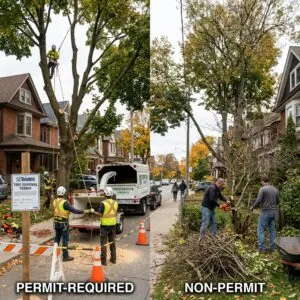
What’s the difference?
Toronto’s two-tier tree removal process often confuses homeowners. In 2026, the city’s bylaws remain clear but enforcement varies by neighborhood and tree species. The fundamental split is straightforward: some trees require a city permit before removal, others don’t. The difference hinges on tree size, location (street vs. private property), species protection status, and whether the tree poses an immediate hazard. A permit-required removal typically takes 4–8 weeks, costs $150–$400 in permit fees alone, and involves arborist reports and city inspection. Non-permit removals happen in days, cost only the contractor’s labor and disposal fees, but carry legal risk if you remove the wrong tree. For Toronto homeowners, this choice directly impacts your timeline, budget, and legal liability. Getting it wrong can mean $10,000+ in fines, forced replanting, or insurance denial if injury occurs. This post breaks down the real decision framework so you can move forward confidently.
Side-by-side comparison
| Scenario | Cost (CAD) | Timeline | Permit Required? | When to Choose | Risk if Wrong |
|---|---|---|---|---|---|
| Tree >30cm diameter, street-facing | $200–$400 permit + $1,500–$4,000 removal | 4–8 weeks | Yes | Large heritage or protected species near sidewalk | $10,000+ fine, forced replanting, court order |
| Tree <30cm, private yard, no hazard | $800–$2,500 removal only | 3–7 days | No | Small fruit tree or non-protected species away from property line | Low if truly exempt; audit tree species if disputed |
| Dead or diseased, any size, emergency | $200 emergency permit + $1,200–$3,500 removal | 1–5 business days | Yes (expedited) | Hazard visible: broken limbs, leaning, uprooted roots | Liability if injury occurs before removal; insurance may deny claim |
| Bylaw-protected species (e.g., oak, elm), any size | $150–$300 permit + $2,000–$5,500 removal | 6–10 weeks | Yes | Species on Toronto’s protected list regardless of location | $15,000+ fine; mandatory replacement planting 1:1 or 1:2 ratio |
| Tree on shared property line or condo | $200–$350 permit + $1,500–$4,000 removal | 5–9 weeks | Yes (survey may be needed) | Ownership/liability unclear; shared maintenance cost | Neighbor lawsuit, shared liability, permit denial if ownership disputed |
| Small shrub/sapling <15cm, fully on your lot | $400–$1,200 removal only | 1–3 days | No | Young non-protected growth; clear ownership; no street frontage | Minimal if truly small and non-protected; document with photos |
Permit-required tree removal — when it’s the right call
Permit-required removal is mandatory for trees over 30 centimeters in diameter at breast height (DBH), most street-facing trees, and all species on Toronto’s protected list (oak, elm, ash, birch, hickory, and others). The permit process exists because large trees provide critical urban canopy, air quality, stormwater management, and property value. When a permit is required, the city wants documentation: an arborist report certifying the tree’s health status, location, and reason for removal. Hazard mitigation is a valid reason—leaning trees, major deadwood, disease, or root damage—but “I don’t like how it looks” is not. Applying for a permit typically costs $150–$400 and takes 4–8 weeks. Your contractor should handle the paperwork, though you remain the applicant. Permits include a city inspection after removal to confirm proper stump grinding and site restoration. The timeline is longer, but you gain legal cover: a permitted removal protects you from liability, your insurance remains valid, and neighbors cannot claim violation. If the tree is hazardous, Toronto offers emergency tree removal permits that expedite the process to 1–5 business days, costing slightly more but eliminating the injury-liability exposure. Choose the permit route if: the tree exceeds size thresholds, it’s on your street frontage, it’s a protected species, or you’re unsure of the rule.
Non-permit removal — when it’s the right call
Non-permit removal applies only to trees under 30 centimeters DBH, non-protected species, and those with no connection to city infrastructure or street-facing location. Common exempt trees include fruit trees (apple, cherry, pear), birch saplings under the threshold, small maples on private lots, and shrubs. The advantage is speed and cost: no waiting, no city fee, no inspection. Your contractor can schedule removal within days, and you pay only the labor and stump grinding—typically $800–$2,500. This route works well for younger trees you’ve planted yourself, or when you’re clearing overgrown private land away from neighbors and easements. However, exemption is conditional: the tree must genuinely be under 30 centimeters DBH (measured at 1.3 meters height), not on the protected species list, and fully within your property boundary. Many homeowners misjudge size or species and face penalties. Non-permit removal offers no city documentation or inspection; if the tree was actually protected and a neighbor reports you, the fine starts at $10,000. Your homeowner’s insurance may also deny a claim if injury occurs during an unpermitted removal of a tree that should have been permitted. Choose non-permit removal only if you are confident the tree meets all exemption criteria, ideally confirmed by your contractor’s free site visit. When in doubt, spend the permit fee—it’s insurance against fines and liability.
Edge cases and Toronto-specific factors
Toronto’s Municipal Code Chapter 349 governs tree protection, but enforcement varies. Downtown core and heritage neighborhoods (Distillery District, Rosedale, The Beaches) see stricter scrutiny; suburbs and industrial zones see lighter monitoring. However, neighbors can report violations at any time, triggering surprise audits and retroactive fines. Property lines matter: a tree rooted on your lot but canopy over a neighbor’s property is still yours to remove (with permit if required), but shared roots or unclear boundaries demand a survey first. Condo owners and co-owners face additional complexity—many condo boards require approval before tree work, and shared trees may need written consent from all owners or a board decision. Easements also apply: utility easements (Hydro One, telecom, water) vest the utility company with removal rights, so notify them before work begins. Insurance is critical. Homeowner’s insurance typically covers contractor injury during permitted work; unpermitted removal may void this coverage. If a tree falls and injures someone, and you removed it without required permits, your insurer can deny the claim entirely, leaving you personally liable. Additionally, trees near power lines require written approval from the utility provider, regardless of permit status. Heritage trees require added scrutiny—some neighborhoods have heritage tree lists beyond the city’s protected list. Finally, replanting obligations are real: removing a protected species often requires planting 1–2 replacement trees (minimum 50mm caliper) within 18 months, adding $600–$1,500 to your total project cost. Request clarity on these obligations before hiring a contractor.
Frequently asked questions
1. How do I know if my tree needs a permit?
Measure the diameter at breast height (1.3 meters up the trunk) with a measuring tape. If it’s 30 centimeters or larger, you almost certainly need a permit. Cross-reference the tree species against Toronto’s protected list (oak, elm, ash, birch, hickory, walnut, cherry, pine, spruce, fir, larch, cedar). If it’s on the list, a permit is required regardless of size. The safest move: hire a contractor to assess it for free—most offer no-charge site visits where they confirm exemption status or draft the permit application.
2. Can I remove a dead tree without a permit?
Not automatically. A dead tree over 30 centimeters still requires a permit, even if it poses a hazard. However, Toronto offers dead tree removal via expedited emergency permits (1–5 business days, $200–$300 fee) if the hazard is documented by a certified arborist. If the tree is already crashing or uprooted, you may remove it immediately and report it afterward, but get an arborist opinion first to protect your liability.
3. What’s the actual cost in Toronto in 2026?
Permit fees are $150–$400. Removal labor ranges $1,200–$5,500 depending on size, location, access, and stump grinding. A typical mid-sized tree (40–60cm diameter) costs $200 permit + $2,500–$3,500 removal = $2,700–$3,700 total. Emergency permits add $100–$200. Always get a written quote before committing; reputable contractors will provide this free after a site visit.
4. Who applies for the permit—me or my contractor?
Your contractor typically prepares the paperwork, but you (the property owner) submit and remain the applicant. This keeps you legally responsible and ensures your name is on the file. Some contractors offer “full-service permitting” where they guide the process; others require you to file. Clarify this in your contract. Either way, allow 4–8 weeks from submission to approval.
5. What happens if I remove a protected tree without a permit?
Fines start at $10,000 for a first violation and can reach $50,000 for repeat offenses or trees of high heritage value. You may be ordered to replant 1–2 trees at your cost ($600–$1,500 each). Neighbors or the city can report the violation at any time, even years later, so retroactive enforcement is possible. Insurance may deny liability claims if injury occurs, leaving you personally at risk.
6. Do I need a permit if the tree is on the boundary between my property and my neighbor’s?
If the tree is rooted on your lot, you need a permit (if required by size/species) before removing it, though the canopy hangs over your neighbor’s yard. If the tree is rooted on the neighbor’s lot, you cannot remove it without their permission and their permit application. If roots are truly shared and ownership is unclear, hire a surveyor ($400–$800) to confirm the boundary before proceeding. This prevents legal disputes and ensures your contractor isn’t liable.
Bottom line
Choose permit-required removal if: your tree is over 30 centimeters in diameter, it’s a protected species (oak, elm, ash, birch, etc.), it’s street-facing, you’re unsure of exemption status, or the tree is hazardous (the emergency permit ensures legal protection and expedited processing). Permit removal takes longer and costs more upfront, but it covers you legally, maintains your insurance, and avoids fines.
Choose non-permit removal if: your tree is genuinely under 30 centimeters DBH, it’s a confirmed non-protected species (fruit trees, young maples on your lot), it’s fully within your property boundary away from easements and utilities, and you have documented confirmation from a qualified contractor. Non-permit removal is faster and cheaper, but only works if the tree truly qualifies—get a professional assessment to be certain.
When in doubt, choose permit removal. The $200–$400 permit fee is cheap insurance against a $10,000+ fine, forced replanting, or insurance denial. A reputable contractor will guide you toward the right choice during a free site assessment. For a no-obligation evaluation and permit guidance, visit torontotreeremoval.ninja for a free quote and professional arborist consultation. In Toronto’s 2026 regulatory environment, clarity upfront saves regret later.