ISA Certified Arborist Toronto: Find, Verify & Hire Right

An ISA Certified Arborist isn’t just a marketing label — it’s a peer-reviewed professional credential that requires 3+ years of hands-on field experience, 300 hours of continuing education, and a passing score on a proctored exam administered by the International Society of Arboriculture (ISA). In Toronto and across the GTA, that credential separates arborists who follow documented, evidence-based methodology from companies that bought a truck and a chainsaw. If you’re dealing with a hazardous tree, filing an insurance claim, or navigating a Toronto Municipal Code Chapter 813 permit, an ISA-certified arborist is the only professional whose written report carries weight with insurers, adjusters, and the City.

This guide explains exactly what ISA certification means, how to verify it in 90 seconds using the official registry, what you should expect to pay in Toronto and the GTA, and the red flags that separate credentialed professionals from uncertified “tree experts” who put your property — and your insurance policy — at risk.

ISA Certified Arborist: What It Means & Why It Matters

The International Society of Arboriculture has certified arboricultural professionals since 1992. The ISA Certified Arborist credential is the baseline qualification — there are also specialty designations including Utility Specialist, Municipal Specialist, Board Certified Master Arborist, and Tree Risk Assessment Qualification (TRAQ). To earn the core certification, a candidate must:

  • Field experience: A minimum of 3 years working in professional arboriculture (planting, pruning, removal, diagnosis, or related tree care).
  • Education hours: Document at least 300 hours of continuing education across the certification period.
  • Examination: Pass a comprehensive proctored exam covering tree biology, soil science, pruning methodology, risk assessment, and diagnosis.
  • Recertification: Renew every 3 years by accumulating continuing education units (CEUs) — the credential expires if not maintained.

That recertification requirement matters enormously for homeowners. A company might have employed an ISA-certified arborist in 2018 whose credential lapsed in 2021 — and they’ll still advertise “ISA certified” years later. The only way to know if a credential is active is to verify it yourself on the live registry (see the step-by-step below).

In Toronto specifically, hiring an ISA-certified arborist matters for three concrete reasons: (1) The City of Toronto’s Urban Forestry division gives greater weight to permit applications and tree protection plans prepared by credentialed arborists. (2) Major Canadian insurers — including TD, Intact, and Aviva — accept ISA-backed written assessments for storm-damage and liability claims. (3) ISA arborists follow ANSI A300 standards, the industry’s peer-reviewed methodology for pruning, removals, and cabling. Non-certified crews are under no obligation to follow these standards, and often don’t.

ISA Certification vs Regular Tree Service: Key Differences

Most homeowners can’t tell the difference between an ISA-certified arborist and a general tree service company from the outside. Both arrive in trucks, both carry chainsaws, and both will quote you a price. The differences show up in written documentation, methodology, and liability — exactly the things that matter when a tree falls on a neighbour’s car or an insurer questions whether your tree was “visibly declining.”

Factor ISA Certified Arborist General Tree Company (Uncertified)
Training standard 3+ years field + 300 CEUs + exam No minimum requirement; self-defined
Methodology Follows ANSI A300 standards for pruning, removals, cabling No obligation to follow industry standards
Written assessment Provides formal written report (Tree Risk Assessment, Arborist Report) Typically verbal quotes only; no formal documentation
Insurance claim use ISA report accepted by major Canadian insurers as evidence of due diligence Report not recognized by insurers; claim may be denied
Liability coverage Required to carry commercial liability (ISA requires proof for membership) Varies widely; many small operators carry minimal or no coverage
Toronto permit support Can sign and certify Tree Protection Plans accepted by Urban Forestry Cannot certify plans; homeowner bears full permit risk
Credential verification Searchable by name on isatrees.org/findanarborist in real time No public verification tool
Recertification Active credential expires; must renew every 3 years N/A

How to Verify an Arborist’s ISA Certification (Step-by-Step)

The ISA runs a public registry at www.isatrees.org/findanarborist. It takes about 90 seconds to confirm whether an arborist’s credential is active. Here’s how to use it before you sign any contract:

  1. Go to isatrees.org/findanarborist. The tool works on mobile and desktop. No account or login required.
  2. Enter the arborist’s last name or company name in the search field. You can also filter by postal code or province (select Ontario) to narrow results.
  3. Locate the individual’s name in the results. Each listing shows: full name, certification type (e.g., Certified Arborist, Utility Specialist), ISA member number, and — most importantly — certification status.
  4. Check the status field. Look for “Active.” If it shows “Expired,” “Suspended,” or the name doesn’t appear at all, the credential is not current. Do not accept a laminated card as proof — the live registry is the only authoritative source.
  5. Note the certification number. Ask the arborist to provide their ISA number before the visit. Cross-referencing the number with the name they gave you is a basic fraud check.
  6. Verify specialty credentials separately. An arborist certified as a “Utility Specialist” or “TRAQ” holder has additional qualifications beyond the base Certified Arborist designation. These are listed separately in the registry.

If an arborist refuses to provide their ISA number before booking, that is itself a red flag. Every credentialed professional knows the number; it’s on their wallet card and in their credential dashboard. A 2-second lookup protects you from paying $800–$3,500 to someone who holds no verifiable qualification.

ISA Certified Arborists in Toronto & Ontario: Where to Find Them

The ISA registry is the primary directory for finding certified arborists by location. Search by Ontario province and then filter to your postal code prefix (M for Toronto, L for much of the GTA) to surface local practitioners. Beyond the registry, here’s what GTA homeowners should know by area:

Toronto (Downtown, East York, Riverdale, Leaside, Forest Hill): The highest concentration of ISA-certified arborists in Ontario operates in the City of Toronto, largely because Toronto’s Chapter 813 bylaw effectively requires credential-backed reports for permit applications covering protected trees over 30cm DBH. Fines for unpermitted removal run $500 to $100,000 — demand from permit-conscious homeowners has built a critical mass of certified practitioners here.

Scarborough: Scarborough’s tree canopy includes significant silver maple corridors and ravine-adjacent properties. Look for ISA arborists who also hold TRAQ (Tree Risk Assessment Qualification) — ravine-adjacent hazard trees need formal risk scoring, not just a visual once-over. You can book an arborist consultation to get a written assessment before deciding on removal vs. mitigation.

North York & Etobicoke: Older neighbourhoods here have mature tree canopies — 60–80-year-old silver maples, oaks, and ash trees that are entering decline. Pre-purchase arborist assessments are increasingly common on Etobicoke and North York property sales. An ISA-certified arborist can produce a written condition report within 48 hours for closing timelines.

Vaughan, Markham & Brampton: Newer subdivisions in these municipalities often have trees planted during site development in the 1990s and 2000s — now reaching sizes that trigger municipal bylaws. Peel Region and York Region have their own tree-protection bylaws that differ from Toronto’s Chapter 813; an ISA-certified arborist familiar with both jurisdictions is essential for any removal or pruning project in these areas. See also our Brampton permit guide for Peel-specific requirements.

Mississauga: Mississauga’s tree bylaw covers trees on private land with a trunk circumference of 50cm or more. ISA-certified arborists in Mississauga can navigate both the bylaw requirements and produce the documentation needed to support exemption applications for dead, diseased, or hazardous trees.

Cost of Hiring an ISA Certified Arborist

ISA certification adds a modest premium to tree services — but the documentation it produces can recover far more than its cost through insurance claims, permit approvals, and avoided fines. Here’s what to expect in Toronto and the GTA as of 2026:

Standalone Assessment / Arborist Report

  • Single-tree written assessment: $200–$400
  • Full arborist report (multi-tree, documented condition scoring): $350–$600
  • TRAQ (Tree Risk Assessment Qualification) formal risk report: $400–$700
  • Permit consultation + report for Toronto Chapter 813 application: $200–$400

ISA Report Added to Removal

Most homeowners want the removal done and the paperwork handled together. When you hire an ISA-certified arborist for a removal, the written assessment typically adds $150–$300 to the removal cost — not a separate engagement. That report documents tree condition, removal justification, and ANSI A300 methodology used, which is exactly what an insurer or city inspector needs.

Full Removal Cost by Tree Size (Toronto GTA, CAD)

Tree Size Removal Cost (CAD) + ISA Report / Assessment Total Range
Small (under 20 ft) $400–$800 +$150–$200 $550–$1,000
Medium (20–40 ft) $800–$1,800 +$200–$300 $1,000–$2,100
Large (40–60 ft) $1,800–$3,500 +$250–$400 $2,050–$3,900
Very Large (60 ft+) $3,500–$8,000+ +$300–$600 $3,800–$8,600+

For a full breakdown of removal costs by tree species, trunk diameter, and neighbourhood, see our Toronto tree removal cost guide.

DIY vs. ISA Certified Pro: What You Actually Get

Task DIY / Uncertified Crew ISA Certified Arborist
Tree risk assessment Cannot produce certifiable report; insurer won’t accept Written TRAQ report accepted by TD, Intact, Aviva
Toronto Chapter 813 permit Application accepted, but no professional backing; harder approval Certified report dramatically increases approval speed and credibility
Insurance claim support Not accepted; insurer may question due diligence ISA-backed assessment proves due diligence; supports full claim value
ANSI A300 pruning standard No training required; “topping” and improper cuts common Follows peer-reviewed methodology; reduces long-term tree stress
Liability on removal Homeowner bears full personal and property liability Contractor’s $5M liability policy covers damage; WSIB covers workers
Emergency response documentation None; post-storm work undocumented Written post-storm assessment backs emergency removal insurance claims

What to Expect from an ISA Certified Arborist

Booking an ISA-certified arborist for the first time? Here’s the standard process for a Toronto-area residential engagement:

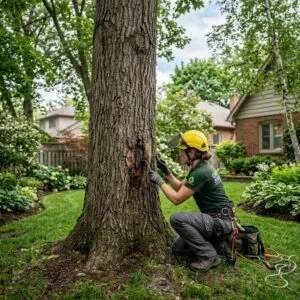
Initial site visit (1–2 hours): The arborist will walk the property, examine the tree(s) in question, assess soil conditions, review proximity to structures and utilities, and document findings. Expect them to use a mallet for density testing, a probe for trunk decay detection, and in some cases a resistograph or sonic tomograph for internal decay mapping on high-value trees.

Written report delivery (24–72 hours): A formal arborist report documents species identification, measured DBH (diameter at breast height — the key metric for Toronto’s 30cm Chapter 813 threshold), condition rating, risk assessment, and a recommended action plan. This report is signed and dated and includes the arborist’s ISA credential number — that number is what an insurer or city inspector uses to verify authorship.

ANSI A300 methodology: All work performed by an ISA Certified Arborist must align with ANSI A300 standards — the American National Standard for Tree Care Operations. These standards cover acceptable pruning cuts, maximum pruning thresholds (generally no more than 25% of the live crown in a single season), cabling and bracing specifications, and removal methodology. Non-certified crews frequently “top” trees — an aggressive pruning practice that ANSI A300 prohibits and that leads to accelerated decay, failure risk, and structural weakness within 3–5 years.

Permit coordination: For Toronto properties with trees over 30cm DBH, your arborist will advise whether a permit is required under Chapter 813. If the tree is dead, diseased, imminently hazardous, or falls under an exemption, they’ll document the exemption justification. If a permit is required, they can prepare or co-sign the application — a step that typically reduces the city’s 5–10 business day review timeline when the file is complete on submission.

Red Flags: How to Spot Uncertified ‘Tree Experts’

The tree service industry is lightly regulated in Ontario, which means anyone can call themselves a “tree expert” without credentials. Here’s how to filter them out before you’re $1,500 into a poorly-executed job:

  • Cannot provide an ISA certification number. A real arborist knows their number. If they hedge, say they’ll “look it up later,” or the name doesn’t appear in the live registry, walk away.
  • Cash-only pricing or pressure for same-day deposit. Legitimate companies accept interac/credit and provide itemized written quotes. Cash-only is a strong signal of uninsured operation.
  • No proof of liability insurance or WSIB coverage. Ask for a current certificate of insurance naming your property as an additional insured for the job. WSIB coverage protects you from liability if a worker is injured on your property. Any credible operator provides both on request.
  • Quotes given without a site visit. You cannot accurately quote a removal over the phone or from a photo. If someone gives you a firm price without seeing the tree, access constraints, soil conditions, and proximity to structures, they’re guessing — and the guess will grow after they arrive.
  • Recommends “topping” as a solution. Topping (removing the upper crown to stubs) is an outdated, harmful practice that violates ANSI A300. Any arborist who recommends topping as a hazard-reduction strategy is either uncredentialed or operating outside accepted standards.
  • Refuses to follow Toronto Municipal Code Chapter 813 or advises ignoring the bylaw. The fines are real: $500 minimum to $100,000 for protected species, with potential injunctions and mandatory replanting requirements. An operator who tells you “the city never checks” is putting your property at risk.
  • No written assessment before work begins. If the only documentation is a verbal “looks fine to me,” you have no protection if something goes wrong.
  • No mention of debris disposal plan. A legitimate arborist will specify whether wood is chipped on-site, hauled away, or left as rounds. Hidden disposal fees are a common upcharge by unscrupulous operators.

Insurance Claims & ISA Reports: Why It Matters

The intersection of tree work and homeowner’s insurance is where ISA certification pays its clearest dividend. Here’s the scenario that plays out dozens of times every GTA storm season: a tree falls, damages a garage or fence, and the homeowner files a claim. The insurer sends an adjuster who asks one question: “Was there any indication this tree was unhealthy before the storm?”

If the answer is yes — and if the homeowner cannot produce documentation showing professional assessment was performed — the insurer may argue the damage was a foreseeable loss that wasn’t mitigated. That turns a covered storm-damage claim into a partial denial or a fight over depreciation.

An ISA Certified Arborist’s written assessment breaks that argument before it starts. The report documents the tree’s condition at the date of assessment, the arborist’s findings, and the recommended action. If the arborist assessed the tree as structurally sound with no immediate removal indication and the tree later failed in a storm, that report is your proof of due diligence. Major Canadian insurers — including TD Insurance, Intact Financial, and Aviva Canada — accept ISA-credentialed reports as evidentiary documentation for storm-damage and liability claims.

The inverse is also true: if an ISA arborist documents a tree as hazardous and recommends removal, and you delay that removal and the tree causes damage, your insurer may argue contributory negligence. Prompt action following an ISA recommendation is itself a risk-management move. For more detail on the insurance dimension of tree removal in Toronto, see our tree removal insurance guide.

“I called three tree companies before TTR. Only their arborist showed me his ISA card, pulled up his credential number on the registry right there in my driveway, and gave me a signed written assessment for $285. My insurer accepted it for the full $4,800 storm-damage claim. The report paid for itself twenty times over.” — Sarah K., Leaside, 2026

Why Choose TTR: ISA Certified, TCIA Member, Serving GTA Since 2010

Toronto Tree Removal Ninja has been serving GTA homeowners, landlords, and property managers since 2010. Here’s what that means in concrete terms when you call 647-558-1366:

  • ISA Certified Arborists on every credentialed job. Our team includes ISA Certified Arborists and ISA Utility Specialists — verifiable right now at isatrees.org/findanarborist. We’ll give you our ISA credential number before we arrive.
  • TCIA Member. The Tree Care Industry Association sets operational and safety standards beyond ISA certification. TCIA membership signals professional-grade equipment protocols and ongoing safety training.
  • $5 million commercial liability insurance. Named additional insured certificates issued on request. WSIB coverage for every crew member means you have zero personal liability for on-site injuries.
  • 15+ years serving all 7 GTA municipalities. We work across Toronto, Scarborough, North York, Etobicoke, Vaughan, Mississauga, Markham, and Brampton — including full familiarity with Toronto Chapter 813, Peel Region tree bylaws, and York Region tree protection standards.
  • 2-hour emergency response. For hazardous trees after storms or ice events across the GTA. See our emergency removal guarantee for coverage details.
  • Written reports included on every assessment engagement. Not verbal quotes — formal written arborist reports with ISA credential numbers, dated and signed, suitable for permit applications and insurance claims.
  • Transparent CAD pricing, no cash-only pressure. Every quote is itemized in writing before work begins.

We’ve completed thousands of removals, assessments, and consultations across the GTA. Our comprehensive FAQ covers the full range of questions homeowners ask — from bylaw specifics to emergency protocols.

FAQ: ISA Certification Questions

What does ISA Certified Arborist actually mean?

ISA Certified Arborist is a professional credential issued by the International Society of Arboriculture. It requires a minimum of 3 years of documented field experience in arboriculture, 300+ hours of continuing education, and a passing score on a comprehensive examination covering tree biology, pruning methodology, soil science, and risk assessment. The credential must be renewed every 3 years through documented continuing education. It is not a trade licence or government certification — it is a peer-reviewed professional designation, similar to a PMP or CPA in other industries. In Ontario, no government body licenses arborists, so ISA certification is the closest equivalent to a recognized professional standard.

How much does hiring an ISA certified arborist add to my tree removal cost?

When an ISA-certified arborist performs both the assessment and the removal, the written documentation typically adds $150–$300 to a removal quote, depending on the complexity of the report required. A standalone written arborist report (no removal) runs $200–$600 in Toronto. A formal TRAQ tree risk assessment report runs $400–$700. For most Toronto homeowners, the added cost is more than recovered through faster permit approvals and insurance claim support — a single approved insurance claim for a $2,000–$5,000 removal/repair job easily justifies the $250 report premium.

Can I trust a tree company that doesn’t have an ISA certified arborist?

For simple work — hauling away a storm-downed limb, grinding a stump — an uncertified crew may be adequate. But for any work requiring a permit, insurance documentation, or formal risk assessment, an uncertified company cannot produce the reports that have legal and financial standing. For any tree over 30cm DBH in Toronto (the Chapter 813 threshold), or for any tree your insurer might scrutinize, ISA certification is not optional — it’s the difference between documentation that holds up and documentation that doesn’t exist.

Does my homeowner’s insurance require an ISA certified arborist for tree claims?

Most policies don’t explicitly require ISA certification by name, but they do require a “professional written assessment” for claims involving structural tree failure, pre-existing disease, or negligence disputes. In practice, insurers accept ISA-credentialed reports as proof of professional assessment; they typically do not accept reports from uncertified tree services. TD Insurance, Intact, and Aviva all have adjusters familiar with ISA credential verification — and they check. Having your arborist’s ISA number documented in the report is the fastest way to clear the “professional assessment” requirement.

How do I verify an arborist’s ISA certification is current?

Go to isatrees.org/findanarborist, enter the arborist’s last name and select Ontario as the province. The result will show their full name, ISA number, certification type, and — critically — whether the credential is “Active” or “Expired.” A laminated wallet card does not prove the credential is current; the live registry does. Ask any arborist you’re considering to provide their ISA number before booking, and verify it yourself. This takes under 2 minutes and is the single most important due diligence step you can take.

What is the difference between ISA certification and TCIA membership?

They’re complementary but distinct. ISA certification is an individual professional credential — it belongs to a specific arborist who passed an exam. TCIA (Tree Care Industry Association) membership is a company-level affiliation that requires adherence to safety standards, business practices, and equipment protocols. A company can be a TCIA member even if not all its employees are ISA-certified, and an arborist can be ISA-certified while working for a non-TCIA company. The strongest signal is both: an ISA-certified arborist employed by a TCIA member company indicates professional standards at both the individual and organizational level. TTR holds both.

What is ANSI A300 and why should I care about it?

ANSI A300 is the American National Standard for Tree Care Operations — a set of peer-reviewed standards covering pruning specifications, cabling and bracing, risk assessment methodology, and removal procedures. ISA Certified Arborists are trained to follow ANSI A300; uncertified crews are not. The most common violation is “topping” — cutting a tree’s crown back to stubs, which ANSI A300 prohibits because it accelerates internal decay, triggers epicormic growth that fails within 3–5 years, and ultimately creates a more dangerous tree than existed before intervention. If an arborist recommends topping as a hazard-reduction strategy, they are either uncredentialed or knowingly operating outside standard practice.

Should I hire an ISA certified arborist for a Toronto tree permit application?

Yes, strongly recommended. Toronto Municipal Code Chapter 813 requires a permit to remove any tree with a diameter ≥30cm DBH (roughly 94cm circumference) on private property within the city. The permit application process — handled by Urban Forestry — moves significantly faster when supported by a credentialed arborist’s report. The typical review period is 5–10 business days; complete applications with supporting arborist documentation are processed more quickly than homeowner-only submissions. Fines for unpermitted removal of a protected tree start at $500 and can reach $100,000 for protected or heritage species. The $200–$400 arborist report that supports a permit application is one of the highest-ROI tree care expenses a Toronto homeowner can make.

Get Your Free Quote Today

Hiring an ISA certified arborist? TTR has been serving Toronto and the GTA since 2010. Verify our ISA credentials directly at isatrees.org/findanarborist before you call. We provide written arborist reports, permit consultation, and full-service removal across all 7 GTA municipalities — with $5M liability, WSIB coverage, and a 2-hour emergency response guarantee.

Call: 647-558-1366 for a free assessment quote.