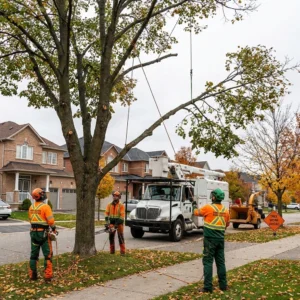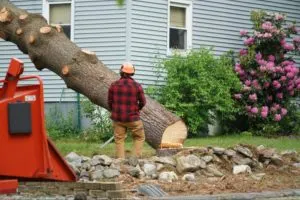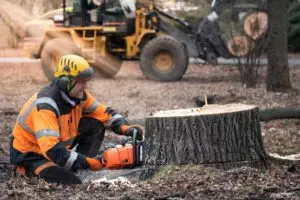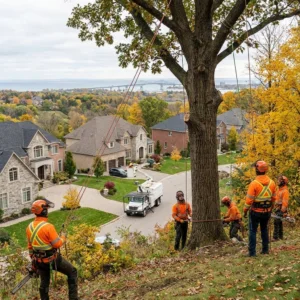
Tree removal in Toronto costs $500–$6,000+ depending on tree size, location access, species, and complexity—with the majority of residential jobs falling in the $800–$2,500 range. Quick answer: Small trees (under 30 ft) cost $500-$800, medium trees (30-60 ft) run $800-$1,500, large trees (60-80 ft) cost $1,500-$3,000, and extra-large trees (80+ ft) start at $3,000 and can exceed $6,000 for difficult removals.
The Quick Answer: What Does Tree Removal Cost in Toronto?
Most Toronto homeowners pay between $800 and $2,500 for professional tree removal. This includes cutting down the tree, processing branches, cutting the trunk into manageable sections, and leaving wood in 18-24 inch rounds on-site (or hauling it away for an additional fee). Stump grinding typically adds $200-$500, permits cost $75-$399 depending on tree size, and arborist reports (required for permits) run $300-$600. Emergency after-hours service carries a premium of 50-100% over standard rates.
The single biggest cost factor is tree height—a 25-foot ornamental cherry tree might cost $600, while an 80-foot silver maple costs $3,500. After height, access difficulty matters most: a backyard tree requiring hand-carry equipment through a narrow side yard costs significantly more than a front-yard tree accessible to bucket trucks and chippers.
How Much Does Tree Removal Cost by Tree Size?
Ontario arborists price primarily by height, measured from ground to highest point in the canopy. Here’s the industry-standard breakdown for Toronto and the GTA:
| Tree Size Category | Height Range | Typical Cost Range | Common Examples |
|---|---|---|---|
| Small trees | Under 30 feet | $500 – $800 | Japanese maple, crabapple, young birch, serviceberry |
| Medium trees | 30 – 60 feet | $800 – $1,500 | Most mature residential trees, young maples, ornamental pears |
| Large trees | 60 – 80 feet | $1,500 – $3,000 | Mature maple, oak, ash, linden—typical Toronto street trees |
| Extra large trees | 80 – 100+ feet | $3,000 – $6,000+ | Old-growth silver maple, cottonwood, large pine, willow |
Why height matters so much: Taller trees require more complex rigging, longer climb times, heavier equipment, and more labor hours. A 30-foot tree might take a two-person crew 2-3 hours; an 80-foot tree with the same diameter could take a four-person crew 6-8 hours, especially if branches need to be lowered carefully to avoid hitting structures or landscaping.
Diameter (trunk thickness) also influences price but is secondary to height. A short, thick tree with a 36-inch diameter might cost $1,200, while a tall, slender tree with a 12-inch diameter could cost $2,000 if it’s 75 feet tall.
What Other Factors Affect Tree Removal Cost in Toronto?
Location and Access
A tree in an open front yard with truck access costs 30-50% less than an identical tree in a fenced backyard accessible only through a 3-foot gate. When crews can’t bring in a bucket truck, chipper, or log truck, they resort to manual rigging, hand-carrying equipment, and hauling brush and wood through tight spaces—all labor-intensive and time-consuming.
Backyard access issues are especially common in Toronto neighbourhoods like:
- Scarborough: Many 1960s-70s bungalows with narrow side yards (under 4 feet) and fenced backyards
- The Beaches: Older homes on small lots with no driveway access, requiring street parking and long carry distances
- Leslieville/Riverdale: Victorian-era homes with tight lot lines, mature trees in rear yards
- High Park area: Protected tree canopy, limited street access, strict city oversight
Expect to pay $500-$1,000 extra for difficult-access removals compared to open-yard equivalents. Some companies charge by the hour for limited-access work rather than flat rates.
Tree Health and Condition
Dead, dying, or structurally compromised trees are more dangerous and unpredictable to remove. Climbers can’t safely ascend dead trees (the wood may crumble under their weight), so removal often requires a bucket truck or crane. Paradoxically, this can make dead trees either cheaper (if crane access is good) or more expensive (if access is poor and extensive rigging is needed).
Trees with significant lean toward structures, co-dominant stems (trunks split into two leaders prone to failure), or heavy decay also increase complexity and risk—reflected in higher pricing.
Proximity to Structures and Obstacles
Trees overhanging roofs, near power lines, between two homes, or surrounded by valuable landscaping require precision cutting and lowering techniques. Each branch must be rigged and lowered with ropes rather than simply dropped, adding hours to the job.
Power lines are a special case: If branches are within 3 meters of power lines, only licensed utility arborists or Toronto Hydro crews can legally work near them. Private tree services must coordinate with the utility, adding delays and costs. Some companies won’t bid on power-line jobs at all.
Species-Specific Factors
Certain species are easier or harder to remove due to wood density, branching structure, and growth patterns:
- Easy/Standard: Maple, ash, birch, linden—typical urban trees with predictable structure
- Moderate: Oak (very heavy, dense wood), pine/spruce (sticky sap, heavy logs)
- Difficult: Willow (unpredictable branch failure, often near water/slopes), cottonwood (weak wood, large size), walnut (extremely dense wood, dulls chainsaw blades quickly)
Species differences might add $200-$500 to a job, though most companies incorporate this into their standard per-foot pricing.
Seasonal Timing
Tree removal demand in Toronto peaks May-September (storm season, most homeowners active, leaves make hazards obvious). Winter (December-February) is slowest, and some companies offer 10-20% discounts to keep crews working. However, winter work has trade-offs: frozen ground makes stump grinding harder, snow complicates access and cleanup, and shorter daylight limits productivity.
Spring and fall offer the best combination of moderate pricing and good working conditions.
What Are the Hidden Costs of Tree Removal in Toronto?
Stump Grinding: $200–$500
Most tree removal quotes do NOT include stump removal—the crew will cut the trunk as close to ground level as possible (typically 6-12 inches above grade) and leave the stump in place. Grinding stumps below grade (so you can replant grass or another tree) requires a separate machine and operator.
Stump grinding pricing depends on diameter: small stumps (under 12 inches) cost $150-$250, medium stumps (12-24 inches) run $250-$400, and large stumps (over 24 inches) cost $400-$700+. Difficult-access stumps (backyards requiring smaller grinders) cost more due to slower grinding rates.
Toronto Tree Removal Permits: $75–$399
Any tree on private property with a trunk diameter of 30cm or more (measured at 1.4 meters height) requires a City of Toronto removal permit. Permit fees are tiered by tree size:
- 30-59cm diameter: $75
- 60-89cm: $150
- 90cm+: $399
Application processing takes 4-8 weeks typically. Emergency removals (dead or imminently hazardous trees) can bypass permits if an arborist certifies the hazard in writing, though you must submit that documentation to the city within 7 days.
For complete permit process details, see our Toronto tree removal permit guide.
Arborist Reports: $300–$600
Toronto requires a formal arborist report for most permit applications, especially for healthy trees or trees in protected areas. The report must include:
- Tree species, size, and health assessment
- Reason for removal request
- Photos and site plan
- Professional arborist’s seal and signature
Basic reports for straightforward cases cost $300-$400. Complex assessments (multiple trees, disputed boundary trees, heritage tree applications) can reach $600-$1,000.
Wood Removal and Disposal: $150–$400
Standard removal quotes include cutting wood into 18-24 inch rounds and stacking them on-site. If you don’t want firewood and need full haul-away, expect an additional $150-$400 depending on tree size. Some homeowners in Etobicoke, Mississauga, and Vaughan list free firewood on Kijiji or Facebook Marketplace—usually claimed within 24-48 hours.
Emergency and After-Hours Service: +50–100%
Same-day emergency removal for trees that have already fallen or are actively failing costs significantly more due to crew availability and urgency. After-hours work (evenings, weekends, holidays) also carries premiums. A tree that would cost $1,200 during regular business hours might cost $1,800-$2,400 as an emergency weekend job.
However, if a tree falls during a storm and damages your home, insurance typically covers emergency removal and related repairs (minus your deductible). Save receipts and document everything with photos.
How Do Toronto Tree Removal Costs Compare to Other Ontario Cities?
Toronto pricing is 10-25% higher than most other Ontario markets due to higher labor costs, stricter permitting, and more complex access scenarios (narrow lots, mature urban forest, heavy traffic affecting street-side work).
| City | Average Medium Tree Removal | Notes |
|---|---|---|
| Toronto | $1,200 – $1,800 | High labor costs, strict permits, access challenges |
| Mississauga | $1,000 – $1,600 | Similar to Toronto, slightly less restrictive |
| Ottawa | $900 – $1,400 | Lower labor costs, less urban density |
| Hamilton | $800 – $1,300 | Lower cost of living, fewer permit requirements |
| London | $700 – $1,200 | Smaller market, more competition drives prices down |
| Barrie | $750 – $1,250 | Rural/suburban mix, easier access typical |
GTA suburbs (Vaughan, Markham, Richmond Hill, Brampton) generally align with Toronto pricing or run 10-15% lower. Rural areas (Caledon, King Township, Uxbridge) may have higher travel charges but lower base labor rates.
How Can You Get Accurate Tree Removal Quotes in Toronto?
Never accept a quote over the phone or from photos alone. Reputable companies require on-site assessments because tree work variables (height, access, proximity to structures, lean, species) can’t be accurately judged remotely. Expect quotes to include:
- Itemized breakdown: tree removal, stump grinding (if included), wood hauling, cleanup
- Scope of work: what’s included, what’s extra, site cleanup standards
- Timeline: when work can be scheduled, estimated duration
- Proof of insurance: minimum $2 million liability, WSIB coverage for crew
- Warranty or guarantee: what happens if damage occurs
Questions to ask when getting quotes:
- Is the company licensed and insured? (Ask for proof—certificates should list your address as additional insured if they’re working on your property)
- Are climbers certified? (ISA Certified Arborist designation is the industry standard)
- What’s included in the price? (Stump grinding, wood removal, permit assistance?)
- How long will it take? (Helps you plan and assess if the quote seems reasonable)
- What happens if you damage my property? (Should be covered by their liability insurance, but clarify the claims process)
- Do you handle permit applications? (Many full-service companies assist with or manage permit paperwork)
- Can you provide references or show recent similar work? (Especially important for large or complex jobs)
Get at least 3 quotes for jobs over $1,500. Price variations of 20-30% are normal and reflect differences in overhead, equipment, experience, and scheduling availability. The cheapest quote isn’t always the best value—verify insurance, check reviews, and assess professionalism during the site visit.
“We had quotes from $1,800 to $3,200 for the same tree in Scarborough. Toronto Tree Removal came in at $2,100, but they were the only ones who spotted that the tree was actually two trees that had grown together—removing just one would save us money and preserve the healthier tree. Their arborist took the time to explain options instead of just bidding the most expensive approach. That kind of honesty earned our business.” — David L., Scarborough
Does Insurance Cover Tree Removal in Toronto?
Ontario homeowner insurance policies typically cover tree removal in these scenarios:
- Storm damage: If a covered peril (windstorm, lightning, ice storm) causes a tree to fall and damage your home, garage, or other insured structure, removal costs are covered under your dwelling coverage
- Sudden failure: If a tree falls unexpectedly and damages insured property (not due to obvious neglect), coverage applies
- Debris removal: Most policies include $500-$1,000 for removing fallen tree debris from your property, even if it didn’t damage structures
Insurance does NOT typically cover:
- Preventive removal of healthy trees (even if you’re worried they might fall)
- Removal of dead or hazardous trees before they cause damage (this is considered maintenance)
- Trees that fall without damaging insured structures (a tree that falls in the middle of your lawn with no property damage is your responsibility)
- Trees removed due to disease, pests, or age-related decline
If you suspect insurance coverage applies, call your insurer before hiring a tree service. They may require specific documentation, preferred vendors, or pre-approval. Keep all receipts, photos of damage, and the arborist’s assessment report.
For preventive removal of hazardous trees, consider whether the cost is worth avoiding potential future damage. A $2,000 removal now might prevent a $15,000 roof repair and insurance deductible later—plus the stress of emergency repairs and displacement.
When Is Tree Removal Worth the Cost vs. Other Options?
Removal isn’t always necessary or the best choice. Consider alternatives:
Crown Reduction Pruning: $300–$1,200
Removing 20-30% of the canopy reduces wind resistance, decreases weight on compromised limbs, and lowers the tree’s profile—often making a marginal tree safer without full removal. This is especially effective for trees leaning toward structures or with minor structural defects.
Cabling and Bracing: $400–$1,500
For trees with co-dominant stems or weak branch unions, steel cables or synthetic braces can provide structural support for decades. This is a common solution for heritage trees, mature oaks, and valuable landscape specimens where removal would significantly impact property aesthetics or value.
Monitoring and Reassessment: $100–$200
If a tree shows early signs of decline but isn’t an immediate hazard, periodic arborist inspections (annually or every 2-3 years) can track progression and time removal for when it’s necessary rather than premature. This is particularly relevant for ash trees with early-stage emerald ash borer infestation—treatment might extend tree life 3-5 years.
When Removal Is the Right Choice
Remove trees that are:
- Dead or dying (more than 50% canopy dieback, extensive trunk decay)
- Structurally unsound (major cracks, severe lean, root failure, hollow trunk)
- Located too close to foundations, causing ongoing structural damage
- Wrong species for the location (invasive species, aggressive root systems like silver maple near sewer lines)
- Prohibited by municipal bylaws in certain areas
Toronto Tree Removal provides free assessments for homeowners uncertain whether removal or treatment is appropriate. Call 647-558-1366 and we’ll send a certified arborist to evaluate your tree’s condition, explain your options, and provide honest recommendations based on safety, cost-effectiveness, and long-term property goals.
Frequently Asked Questions: Tree Removal Costs Toronto
How much does it cost to remove a 50-foot tree in Toronto?
A typical 50-foot tree in Toronto costs $1,000–$1,800 to remove, depending on access, species, and proximity to structures. Open front yard access with truck and chipper availability generally falls in the $1,000–$1,300 range, while backyard trees requiring hand-carry equipment and manual rigging run $1,400–$1,800. Add $250–$400 for stump grinding and $75–$150 for permit fees if the tree is 30cm+ diameter.
Why do tree removal companies charge so much?
Tree work is one of the most dangerous occupations in North America, with high equipment costs ($80,000–$150,000 for a bucket truck, $15,000+ for a commercial chipper), expensive insurance ($10,000–$25,000 annually for adequate liability coverage), specialized training (ISA certification requires years of experience), and high labor costs (skilled climbers earn $25–$40/hour). A crew of 3–4 workers plus equipment overhead easily costs $200–$300 per hour to operate—and large tree removals can take 6–8 hours or more.
Can I negotiate tree removal prices in Toronto?
Some negotiation is possible, especially for: (1) multiple trees removed in one visit (companies may discount 10-15% per additional tree); (2) off-season work (winter scheduling); (3) accepting wood on-site instead of full haul-away; or (4) flexible scheduling (fill-in work when crews have gaps). However, lowball offers below market rates often mean the company is uninsured, inexperienced, or will cut corners—tree work is one area where the cheapest option frequently costs more in the long run through property damage or incomplete work.
Do I need to pay for tree removal upfront?
Reputable tree service companies in Ontario typically require payment upon completion, not upfront. Some may ask for a deposit (10-25%) for large jobs requiring crane rental or scheduling multiple days, but full prepayment is unusual and should be a red flag. If a company insists on 100% payment before starting work, verify their legitimacy, check references, and ensure insurance certificates are current. Most companies accept e-transfer, credit cards, or cheques on completion day.
What’s included in a standard tree removal quote?
Standard removal includes: cutting down the tree, processing all branches through a chipper, cutting trunk wood into 18–24 inch rounds and stacking on-site, raking up debris, and removing all brush. It does NOT typically include stump grinding (add $200–$500), full wood haul-away (add $150–$400), permit fees ($75–$399), arborist reports ($300–$600), or work beyond the tree itself (fence removal/reinstallation, landscape repair, etc.). Always confirm exactly what’s included before signing.
⭐ See our Google Reviews |
📍 Find us on Google Maps |
⭐ Read our Trustpilot Reviews
Get Your Free Tree Removal Quote Today
Toronto Tree Removal provides transparent, detailed quotes with no hidden fees or surprise charges. Our certified arborists assess your tree on-site, explain all options, and deliver written estimates that clearly itemize every cost. We’re fully insured, WSIB-compliant, and experienced with Toronto’s permit process.
What you get with every quote:
- Free on-site assessment (non-emergency jobs)
- Written estimate with cost breakdown
- Honest evaluation—we’ll tell you if removal isn’t necessary
- Permit assistance (we handle paperwork if needed)
- Proof of $2M+ liability insurance and WSIB coverage
- Serving Scarborough, Etobicoke, North York, Vaughan, Mississauga, Markham, Brampton, Richmond Hill, and all Toronto
Call 647-558-1366 or visit torontotreeremoval.ninja for your free quote. We typically schedule assessments within 2-3 business days, with emergency evaluations available same-day or next-day.