Stump Grinding vs Stump Removal for Toronto Homeowners: Which Should You Choose in 2026?
What’s the difference?
After a tree comes down in your Toronto yard, you’re left with a stump—and two distinct paths forward. Stump grinding grinds the stump below ground level using a specialized machine, leaving the roots largely intact but unusable. Stump removal pulls the entire stump and root system out of the soil, leaving a hole that needs backfilling. For Toronto homeowners in 2026, the choice hinges on budget, timeline, land use plans, and local bylaw compliance. Many properties in older neighbourhoods (Leslieville, The Annex, Riverdale) face tight lot lines and underground utilities, making one method safer than the other. Others have sprawling yards perfect for either approach. This guide walks you through the real trade-offs so you can make an informed decision without guesswork or costly mistakes.
Side-by-side comparison
| Factor | Stump Grinding | Stump Removal |
|---|---|---|
| Typical cost (Toronto) | $300–$800 CAD | $800–$2,500 CAD |
| Timeline | 1–2 hours (same day) | 1–3 days (excavation, backfill) |
| Permit required | No (in most cases) | Possible (check local bylaw) |
| Best if you plan to: | Plant grass, garden, patio soon; minimal disturbance wanted | Build a deck/shed; expand driveway; level the lot |
| Key risk if wrong choice | Stump sprouts regrow; roots cause foundation/pipe damage over years | Large hole requires expensive fill; soil settling causes uneven ground |
| Utility damage risk | Lower (machine stays above ground) | Higher (excavation may strike gas/hydro/sewer lines) |
| Residual roots in soil | Yes (eventual decay, 5–10 years) | No (complete extraction) |
Stump grinding — when it’s the right call
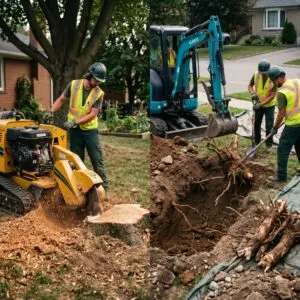
Stump grinding is the faster, cheaper option and suits most Toronto residential properties. A certified arborist operates a self-propelled grinder that chips the stump into mulch chips, typically grinding 12–18 inches below the original ground level. This approach works well if you’re planning to seed lawn within weeks, install a garden bed, or build a patio overtop. The grinding process is loud (1–2 hours) but leaves your yard otherwise undisturbed—no excavation, no backhoe marks, minimal soil compaction.
Choose grinding if your budget is tight and you have no immediate plans for subsurface work on that spot. The leftover wood chips become free mulch you can spread elsewhere in the yard. Roots left behind will decay naturally over 5–10 years, and the risk of them damaging foundations or utilities is low if the stump was far from your house (generally 10+ feet). In dense Toronto neighbourhoods where lot sizes are small and backyards are shared walls, grinding keeps disruption minimal. Many homeowners in Parkdale, Little Italy, and the Distillery District prefer grinding for this reason alone. Be aware: regrowth is possible if the stump is treated improperly, and some species (maple, ash, elm) are more prone to sprouting from roots. A professional will apply herbicide to cut surfaces to prevent this.
Stump removal — when it’s the right call
Full stump removal is the complete solution when you need to reclaim the entire footprint and have a specific future use for that space. Removal involves excavating around the stump, cutting large roots, and pulling the stump and root ball free—often with a backhoe or stump puller. This method suits Toronto homeowners planning to build a deck, install an above-ground pool, extend a driveway, or level a sloped lot. Once the hole is backfilled with clean topsoil and compacted properly, the land is fully usable with no underground hazards.
Removal is necessary in some cases by bylaw, especially if the stump is within a foundation-damage zone or near underground utilities. Full excavation is quoted on site, depending on stump size, root depth, and soil composition. Removal takes longer (1–3 days) because excavation and backfill must be done carefully to avoid settling. If you’re in an older neighbourhood near sewer or gas lines, removal is often safer than grinding because the contractor can visually inspect and carefully hand-dig around utilities. It’s also the only option if you plan major construction, landscaping reshaping, or if the stump is in a foundation-risk zone. The trade-off: higher upfront cost and temporary yard disruption.
Edge cases and Toronto-specific factors
Toronto’s 2026 bylaw environment requires attention. The City of Toronto Municipal Code Chapter 349 (Trees) mandates tree permit compliance before removal; stump disposition after removal isn’t always explicitly controlled, but removal applications may require proof of proper stump handling. If your removal triggered a city permit, closure paperwork may reference stump disposal. Grinding typically needs no separate permit since it’s considered maintenance on already-removed wood.
Insurance liability is another consideration. If roots from a left-in-place stump cause damage to a neighbour’s foundation or utilities, liability can fall on you. Removal eliminates this risk entirely. In semi-detached and townhouse areas (common in South Etobicoke, Scarborough, and North York), shared foundation walls make root-related claims more likely. Neighbourhood covenants may also restrict underground hazards. Finally, soil conditions matter: Toronto has clay-heavy soil in many zones, which compacts poorly after backfilling—meaning removal-site settling is common. Professional backfill with proper compaction is worth the extra cost to avoid a sinkhole in your yard in 2–3 years.
Frequently asked questions
1. Will a stump regrow after grinding?
Regrowth is possible but preventable. A professional grinder applies herbicide to fresh-cut surfaces immediately after grinding, killing dormant buds. Species like maples and elms are more prone to sprouting than oaks or birches. If sprouting occurs, it’s usually minor and easily controlled with follow-up herbicide or manual removal. Full removal eliminates regrowth risk entirely.
2. How deep do roots go, and could they damage my foundation?
Tree roots typically spread horizontally rather than deeply—most are in the top 18–24 inches of soil. Damage to Toronto foundations (typically stone or concrete 3–4 feet below grade) is rare unless roots grew directly under the house for decades. After removal, the risk drops to near zero. If the stump is more than 10 feet from your house, grinding is generally safe. Closer than that, consult a certified arborist before deciding.
3. What if there are utilities under the stump?
Call 811 (North One Call) before any work to mark gas, hydro, and water lines. Grinding poses minimal risk to utilities since the grinder operates above ground. Removal with excavation is higher-risk and requires careful hand-digging once utility marks are in place. Your contractor must be experienced with Toronto’s underground infrastructure—older neighborhoods have shallow, unpredictable line placement.
4. Can I build a deck on a ground where a stump was ground?
Yes, but ideally wait 6–12 weeks and check that the ground has settled. The soil compaction is lighter after grinding than removal-and-backfill. If you’re building a deck, ground-level posts can rest on the spot, but deep post holes (for deck footings) should avoid the old root zone if possible. Your deck contractor should do a soil assessment first. For removal, proper backfill and compaction makes immediate deck building safe.
5. How much does stump removal actually cost in Toronto in 2026?
Expect $150–$250 CAD for grinding with a removal ($200–$400 CAD on its own); full excavation is quoted on site. Prices vary by stump diameter (small stumps under 12 inches are cheaper), root complexity, and contractor demand. Get 2–3 quotes and ask for itemized breakdowns. Emergency or same-day work may cost more. For a free estimate from a certified professional, contact a local arborist.
6. Is grinding environmentally better than removal?
Grinding is gentler on soil and leaves wood chips for mulch, reducing waste. Removal displaces more earth and requires backfill trucking, using more fuel. However, grinding leaves roots underground, which take years to decompose. Removal is cleaner from a long-term land-use perspective. Neither method is inherently “green”—it depends on your future land plans and local soil recovery priorities.
Bottom line
Choose grinding if: Your budget is under $1,000 CAD, you want the stump gone in a single afternoon, and you have no immediate plans to build or dig on that spot. Grinding suits most Toronto residential yards, especially in dense neighbourhoods where minimizing disruption matters. It’s perfect for homeowners planting new lawn or gardens.
Choose removal if: You’re planning construction (deck, pool, extension), your lot needs leveling, or the stump is dangerously close to your foundation or utilities. Full excavation costs more (quoted on site) and takes longer, but it’s the complete solution for future-proofed land use. It’s also the safer choice in neighbourhoods with aging underground infrastructure or shared foundation concerns.
When in doubt, consult a professional: A certified arborist can assess your specific stump, check utility locations, review your Toronto bylaw compliance, and recommend the right method. Every property is different. Visit toronto tree removal ninja to schedule a free site assessment and written quote. Our team has removed and ground thousands of stumps across Toronto and understands the nuances of each neighbourhood’s soil, bylaws, and underground conditions. Make the call now—waiting years to address a stump often costs more when roots or regrowth becomes a problem.