Residential vs Commercial Tree Removal Toronto: Insurance & Permits

A single homeowner removing a backyard oak and a condo property manager clearing a parking-lot tree both call an arborist — but the jobs are almost nothing alike. Residential tree removal in Toronto typically runs $800–$3,500 per tree, wraps up in 45 days, and needs one permit. A commercial multi-tree project at a condo or retail plaza can run $10,000–$50,000+, take 60–90 days, and require insurance certificates, WSIB clearance, a site safety plan, and formal condo board approval before a single cut is made. If you’re a property manager, facilities lead, or condo board director searching for clarity, this guide lays out every difference that matters — including the ones your contractor won’t always mention up front.

Residential vs Commercial Tree Removal: Key Differences

The table below captures the core workflow split at a glance. Every row below is expanded in detail through this guide.

Factor Residential Commercial
Who initiates Single homeowner Property manager / condo board / developer
Typical tree count 1–3 trees 5–50+ trees across multiple locations
Site type Private backyard, driveway access Condo lot, retail plaza, office park, parking area
General Liability required $2M per occurrence $5M per occurrence (min.)
WSIB clearance Recommended Mandatory — condo board liability exposure
Chapter 813 permit Yes (≥30 cm DBH, filed by homeowner) Yes + possible Chapter 307 ravine overlay
Pricing model Per-tree fixed quote Day-rate or project-rate contract
Timeline ~45 days start to finish 60–90 days (pre-work approvals add 2–3 weeks)
Contract 1-page standard T&C 5–10 page BOA with indemnification & change-order process
Site coordination Homeowner only Property manager + facilities + condo board + residents

Residential Tree Removal: Single Homeowners, Small Projects

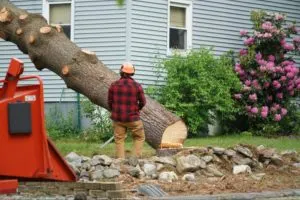
Residential jobs are the backbone of most GTA arborist businesses — and the format most Toronto homeowners picture when they think “tree removal.” You call for a free estimate, a certified arborist walks your yard, quotes the job, you pull a Chapter 813 permit if the tree is 30 cm DBH or larger, and within 45 days the tree is down and the stump is ground. Simple.

Typical residential project scope:

  • Small tree (under 30 ft / 9 m): $800–$1,400 including debris haul
  • Medium tree (30–60 ft): $1,400–$2,500
  • Large tree (60–80 ft): $2,500–$4,500
  • Stump grinding: $250–$450 per stump (often quoted separately)

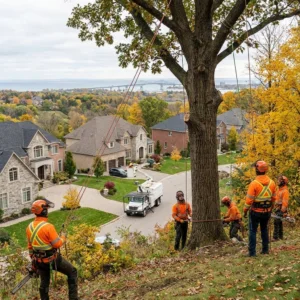
Access is usually via a side gate or driveway — tight, but manageable with a bucket truck or aerial lift. The peak residential season in Toronto and Scarborough runs May through August, when homeowners notice winter damage and landscaping contractors flag problem trees. A late-May booking in North York or Etobicoke typically gets crew on-site within two weeks of permit approval.

Liability on a residential job is straightforward: TTR carries $5M commercial general liability, sets perimeter cones, posts “do not enter” signs around the work zone, and wraps up in a single visit. No public walkways to manage, no retail tenants to notify, no insurance procurement delays.

For homeowners comparing options, see our full tree removal service page or call 647-558-1366 for a same-day quote.

Commercial Tree Removal: Property Managers, Multi-Site Operations

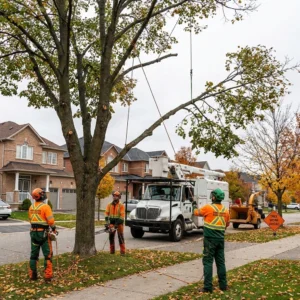
Commercial tree removal is a different discipline. If you manage a 150-unit condo in Vaughan, a strip mall in Mississauga, or an office campus in Markham, a tree removal project isn’t just about cutting wood — it’s a capital project with procurement rules, insurance requirements, board approvals, resident notifications, and scheduling windows that cannot slip.

Commercial scope examples:

  • Condo complex (12 trees, 3 building locations): $14,000–$18,000 project-rate (includes site coordination, permit admin, debris haul)
  • Retail plaza (5 hazard trees near parking): $6,000–$10,000 + traffic control plan
  • Office park lot clearing (20+ trees): $25,000–$50,000 day-rate contract

Why the premium? Commercial crews carry heavier insurance, coordinate with multiple stakeholders, file multiple permits, and often work restricted hours (7 a.m.–5 p.m., no weekends on condo properties). That cost is real and it’s justified — a condo board that hires an underinsured residential crew and has a resident or visitor injured during work could face a six-figure liability claim not covered by the contractor’s $2M residential policy.

TTR serves commercial clients across the GTA — from Brampton industrial sites to Scarborough condo boards to Etobicoke property management portfolios. Our commercial tree removal page outlines scope and contracting options.

Insurance Requirements: Residential vs Commercial

Insurance is where the residential-vs-commercial gap matters most — and where property managers most often get burned by cutting corners on contractor vetting.

Project Type Min. GL Required Additional Certificates Procurement Lead-Time
Residential (homeowner) $2M per occurrence None required 2 days to receive cert
Commercial (project value under $2M) $2M GL + WSIB clearance Loss-of-revenue insurance (optional) 5–7 business days
Commercial (project value $2M+, high-risk) $5M GL + WSIB + Environmental Liability Certificate of Insurance naming client as certificate holder 10–14 business days (multi-layer approvals)

Why WSIB clearance matters for condo boards: If TTR’s crew member is injured on your condo property and TTR is not WSIB-registered, your condo corporation can be held liable for medical costs, lost wages, and legal fees — up to $500,000 under Ontario’s Workplace Safety & Insurance Act. A current WSIB clearance certificate (downloadable from wsib.ca) confirms TTR is registered and fully covered. It expires annually — always request a current copy dated within 60 days.

Named additional insured: For projects over $50,000, property managers should request to be added as an additional insured on TTR’s liability policy. Cost to you: $0 (TTR pays the rider, typically $100–$200/year per additional insured). Benefit: if a third party sues over a removal accident, TTR’s insurer defends your condo corporation too — not just TTR. That’s meaningful risk transfer for a 200-unit building with $15M in reserve funds.

For a full breakdown of tree removal insurance coverage and claims, see our tree removal insurance guide.

Chapter 813 Permits: Residential Private Trees vs Commercial Projects

Toronto Municipal Code Chapter 813 applies equally to residential and commercial private trees — any tree measuring 30 cm DBH or greater on private property requires a permit before removal. No exceptions for property type. Fines for unpermitted removal run $500 to $100,000 per tree depending on species and intent.

But the commercial layer adds complexity:

Example A — Residential: A 40 cm oak in a Scarborough backyard. Homeowner files Chapter 813 application ($100 permit fee), city reviews in 4–30 business days, permit issued. Removal cost: $1,500 + $100 permit = $1,600 total. Timeline: ~35–45 days.

Example B — Commercial redevelopment: Same 40 cm oak, but it’s on a commercial condo redevelopment site in a ravine zone. Chapter 813 applies AND Chapter 307 (Ravine and Natural Features) triggers a separate review requiring: a tree retention/protection plan ($1,000–$3,000 consultant fee), replanting fund ($1,500–$5,000 deposited with the city), and a 12-week approval timeline. Total additional cost vs. residential: $3,000–$8,000. Timeline: 12–16 weeks.

Key point for property managers: Before signing a removal contract, have your arborist confirm whether any trees are in the ravine overlay. Chapter 307 zones cover large portions of Scarborough, North York, Etobicoke, and Vaughan. Missing this adds months and thousands to your project budget. TTR conducts a full bylaw review as part of every commercial assessment — no surprises.

Site Safety & Liability: Residential vs Commercial Workflows

Residential workflow: TTR sets perimeter cones and “Do Not Enter” signage around the drop zone. Homeowner keeps family and pets indoors during the cut. No public safety plan required, no air-space permits, no municipal right-of-way coordination (unless the tree overhangs the boulevard).

Commercial workflow: High-risk sites — parking lots, retail plazas, pedestrian walkways — require a full site safety plan before work begins. TTR coordinates with the property manager’s facilities team to:

  1. Map the work zone and identify all pedestrian and vehicle routes within 50 metres
  2. Design a traffic control plan (flagged lanes, temporary perimeter fencing) if work impacts movement
  3. Arrange 24/7 security presence if the site remains open overnight
  4. Schedule work for off-peak hours — condo sites typically 7–9 a.m. before residents leave for work
  5. File a site safety plan with the city if work affects the public right-of-way

For condo boards: TTR prepares a resident notice (bulletin board + email draft) listing work dates, noise windows, and restricted parking zones. Board meeting approval is typically required 2+ weeks before scheduled start. This isn’t bureaucracy for its own sake — a single slip-and-fall claim near an active removal site can exceed your entire project budget in legal fees alone.

Need emergency removal before the site plan is ready? Our emergency tree removal service covers 2-hour response with immediate safety assessment — Chapter 813 has an emergency exception for imminent-hazard trees.

Pricing Models: How & Why Commercial Costs More

Residential pricing is simple: one tree, one fixed quote. Commercial pricing uses day-rate or project-rate contracts because multi-tree, multi-location jobs don’t fit per-tree math.

Cost by Tree Size (Residential vs Commercial Site)

Tree Size Residential (per tree) Commercial Site (per tree equivalent) Why the Gap
Small (<30 ft) $800–$1,200 $1,000–$1,600 Mobilization, public-liability overhead
Medium (30–60 ft) $1,400–$2,500 $1,800–$3,200 Site coordination, staggered scheduling
Large (60–80 ft) $2,500–$4,500 $3,200–$6,000 $5M GL insurance overhead + equipment mobilization
Stump grinding $250–$450/stump $300–$550/stump Multi-unit coordination, access restrictions

Why does commercial cost 20–30% more per tree?

  1. Mobilization: Commercial crews travel to 3 building locations on a condo property vs. one residential address — equipment loadout, fuel, and time are real costs.
  2. Insurance overhead: TTR maintains a $5M commercial GL policy specifically for property management clients. That policy costs more than a $2M residential policy — the difference is priced in.
  3. Scheduling complexity: “Remove the tree by August 1 for landscaping” is a hard deadline. Meeting it requires additional crew planning, pre-work site visits, and coordination time billed to the project.
  4. Public liability exposure: Condo residents walking past an active work zone during stump grinding create a higher injury-claim risk than a locked residential backyard. Risk = insurance premium = cost.

DIY vs Professional Tree Removal: Residential vs Commercial

Scenario DIY Professional (TTR)
Small residential tree (<20 ft, no permit) Possible — saw, $200-$300 tool rental $800–$1,200 — recommended for safe felling zone
Residential tree ≥30 cm DBH Illegal without permit; $500–$100K fine risk $1,200–$3,500 — includes permit admin
Any commercial site tree Never — liability void, condo insurance exposure $1,800–$6,000+/tree — full insurance + WSIB coverage
Ravine zone tree (any type) Illegal — Chapter 307 permit required $2,500–$8,000 — includes Chapter 307 filing

Timeline & Scheduling: Residential vs Commercial Prep

Residential timeline (45 days typical):

  1. Day 1 — Call for free estimate
  2. Day 3 — Site visit + fixed quote
  3. Day 5 — Submit Chapter 813 permit application
  4. Days 5–35 — City review (4–30 business days)
  5. Day 38 — Schedule removal (crew availability)
  6. Day 45 — Tree removed, stump ground, site cleared

Commercial timeline (60–90 days typical):

  1. Day 1 — Initial phone assessment with property manager
  2. Day 3 — On-site visit with PM + review building/site plans
  3. Day 7 — TTR prepares site safety plan + liability checklist
  4. Day 10 — Submit Chapter 813 (+ Chapter 307 if ravine zone)
  5. Day 12 — PM reviews TTR insurance certs, WSIB clearance; adds TTR as certificate holder
  6. Days 10–42 — City review (35 days for 813; up to 12 weeks if 307 applies)
  7. Day 38–45 — Coordinate with condo board (board meeting approval, resident notice)
  8. Day 48 — Final site walkthrough with facilities + security team
  9. Days 50–65 — Removal execution and site restoration

Property managers: start 10–12 weeks before your hard deadline. If your condo’s landscaping contractor is booked for September 1, tree removal must be complete by August 15 — which means permit applications go in by late May at the latest. TTR can accelerate timelines when needed, but city permit review windows are fixed.

“We manage three condo properties in Vaughan and had a hard August deadline for line-of-sight trees near the parking garage. TTR filed our Chapter 813 permits, coordinated with our board, and completed all 11 trees in two days — came in at $16,400 total, exactly on quote. First contractor we’ve had that actually understood commercial insurance requirements.” — Marcus L., Senior Property Manager, Vaughan, 2026

For location-specific scheduling across the GTA, see our pages for Scarborough, North York, and Mississauga.

Contractor Vetting: What Property Managers Should Ask

Before signing any commercial tree removal contract, send every candidate contractor this eight-point checklist. If they can’t answer all eight promptly, move on.

  1. ISA Certified Arborist on staff? Verify via isa-arbor.com/arboristlocator. Certification number should match a current listing — it expires every 3 years.
  2. WSIB clearance certificate? Request a current copy (dated within 60 days). Download directly from wsib.ca/en/businesses/clearances or accept an emailed PDF from the contractor. Expired = unacceptable.
  3. Commercial GL insurance — minimum $5M per occurrence? Request the actual Certificate of Insurance (COI) — not verbal assurance. Check: insured name matches contractor, policy number is active, expiry date is 60+ days out.
  4. Named Additional Insured available? “Can you add our condo corporation as additional insured?” If the answer is anything other than “yes,” walk away.
  5. Environmental Liability Insurance? Required if your site is on former industrial land, near a ravine, or involves contaminated soil. Ask if it’s included or available as a rider.
  6. Three commercial references in the past 24 months? Call them. Ask specifically: did the crew stick to the schedule? Were change orders handled in writing? Was the site clean post-removal?
  7. Site safety plan process? Ask “What does your site safety plan include for a condo parking lot?” If they look blank, they don’t do commercial work regularly.
  8. Change order process? “If a tree is larger than estimated, how do you handle the cost difference?” The right answer: written change order submitted before work continues, no surprises on the final invoice.

TTR provides WSIB clearance, $5M COI, named-additional-insured setup, and site safety plans as standard on all commercial contracts. Book a commercial consultation or call 647-558-1366.

Contract Terms: Residential Standard vs Commercial BOA

Residential contract (1-page standard): Cost, scope, timeline, payment (50% upfront, 50% on completion), and a 30-day stump re-sprout warranty. No insurance language, no liability caps, no change-order clauses needed — the scope is fixed and risks are low.

Commercial contract (5–10 page BOA — Basic Order Agreement):

  • Scope of Work: Species, DBH, GPS location, removal method, debris handling, site restoration — itemized per tree.
  • Insurance & Indemnification: TTR carries $5M GL and names property manager as additional insured. TTR indemnifies client against third-party injury claims arising from TTR’s work.
  • Change Order Procedure: If a tree is larger than estimated or unforeseen root conflict arises, TTR submits a written change order for property manager approval before proceeding. Zero “surprise” charges on final invoice.
  • Schedule: Fixed start/end dates. Liquidated damages if TTR delays beyond agreed completion date (typically $500/day). This is standard and protects your landscaping and downstream projects.
  • Payment Terms: ⅓ deposit at contract signing, ⅓ at project midpoint (50% complete), ⅓ on substantial completion. TTR retains lien rights on holdback per Ontario Construction Act.
  • Dispute Resolution: Mediation first, then binding arbitration — avoids the time and cost of court litigation.

Don’t sign a commercial tree removal contract that lacks the change-order clause and liquidated damages provision. These are standard in the construction industry and protect both parties.

GTA Neighbourhood Breakdown: Commercial Tree Removal Across the Region

Commercial demand varies significantly by GTA area based on condo density, age of tree stock, and proximity to ravine zones:

  • Toronto (downtown / midtown): High-rise condo boards, streetscape trees, tight access. Chapter 813 permits required for almost all removals. High permit volume = 30-day review timelines are common.
  • Scarborough: Mature suburban tree stock (oaks, maples, silver maples). Many properties in ravine overlay — Chapter 307 frequently triggered. Condo corridor along Kingston Rd. has active commercial demand.
  • North York: Apartment and condo strip along Yonge/Sheppard corridor. Boulevard trees managed by Urban Forestry — coordinate before removing anything near the curb. TTR handles North York commercial work regularly.
  • Etobicoke: Industrial and commercial corridors (Dixie/Kipling) plus mature residential condo properties. Environmental liability insurance sometimes required near former industrial parcels.
  • Vaughan: Active new-development market — commercial lot clearing, tree protection plans for site plan applications, pre-construction ISA reports. High permit volumes at Vaughan City Hall.
  • Mississauga: Large commercial campuses, strip malls, and condo towers. Peel Region tree bylaw runs parallel to Toronto Chapter 813 — slightly different DBH thresholds. TTR serves Mississauga commercial clients under Peel rules.
  • Markham: Growing condo market in Unionville and Cornell. City of Markham’s tree protection rules closely mirror Toronto’s — $5M GL standard for commercial contracts. See Markham tree removal.
  • Brampton: Rapid residential and commercial development. Many large-lot commercial properties with mature tree inventories; lot-clearing projects common. See our Scarborough and Brampton service areas.

Why Choose TTR for Commercial Tree Removal

Property managers across the GTA choose Toronto Tree Removal Ninja for commercial contracts because we check every box on the vetting list — no follow-up calls, no scrambled insurance certs, no “we’ll figure out the site plan on the day.”

  • ISA Certified Arborist on every commercial project — credentials verified, current
  • TCIA member — industry standard safety and training compliance
  • $5M commercial general liability — standard on all commercial engagements
  • WSIB clearance current — provided with every commercial quote package
  • 15+ years GTA experience — condo boards, strip malls, office campuses, developers
  • 2-hour emergency response for hazard trees that can’t wait for permits
  • Named Additional Insured — we add your condo corporation at no extra cost
  • Recurring-service discounts — 15–20% for property managers with 3+ properties; annual maintenance contracts from $5,000/year

Managing trees across a condo portfolio means dealing with the same compliance headaches every year. TTR’s recurring-service model handles annual inspections, permit renewals, and seasonal removal on a single contract — so you’re not re-qualifying a contractor every spring.

FAQ: Commercial vs Residential Tree Removal Questions

My 150-unit condo has 10 trees to remove — do I need a commercial arborist or can a residential crew handle it?

A residential crew can physically do the work, but a commercial crew is the right call for three reasons: (1) 10 trees is a multi-day project where day-rate pricing delivers better value than 10 separate residential quotes. (2) Condo coordination (TTR liaises with your property manager, facilities team, and board — you don’t manage the crew). (3) Insurance: your condo’s general liability policy typically requires contractors to carry $5M GL. Most residential crews carry $2M — leaving a $3M gap that your condo corporation is exposed to if someone gets hurt during work.

What is a WSIB clearance certificate and why does my condo board need it?

WSIB is Ontario’s workers’ compensation insurer. If a TTR crew member is injured on your condo property and TTR isn’t WSIB-registered, your condo corporation can be held liable for medical costs, lost wages, and legal fees — potentially $250,000–$500,000 in exposure. A WSIB clearance certificate (current copy, dated within 60 days from wsib.ca) proves the contractor is registered. Always request it before signing. Expired or missing = red flag; don’t proceed.

Why does commercial tree removal cost 20–30% more per tree than residential?

Five reasons: (1) Mobilization to multiple building locations on one site. (2) $5M GL insurance overhead — that policy costs more than a $2M residential policy. (3) Site safety planning, resident notifications, and condo board coordination time. (4) Day-rate scheduling with hard deadlines = premium crew availability. (5) Public liability exposure on condo properties (residents walking past active work zone). The premium is real and the risk management it buys is worth it — one uninsured injury claim costs more than the 30% difference.

How do Chapter 813 permits work differently for commercial projects?

Chapter 813 applies equally to all private property trees ≥30 cm DBH — residential or commercial. The difference is when the site is in a ravine overlay zone (Chapter 307). Ravine-zone commercial projects require a separate application, a tree retention plan ($1,000–$3,000), a replanting fund deposit ($1,500–$5,000), and a 12-week review timeline. For a non-ravine residential removal: $100 permit fee, 4–30 day review. For a ravine-zone commercial project: $3,000–$8,000 extra, 12–16 weeks. Check your site’s overlay status before quoting a project timeline.

My condo board wants the trees removed by August 1 for landscaping. A contractor offered “completion by July 31 but not guaranteed.” Should I sign?

No. “Not guaranteed” in a commercial contract is unacceptable when you have a downstream landscaping commitment. Insist on: (1) “Scheduled completion: July 25” (5-day buffer). (2) Liquidated damages — $500/day if crew doesn’t finish by July 25. (3) Written change-order clause so scope changes don’t cause delays without your approval. Your landscaper is booked September 1. A week’s delay cascades into a $5,000–$10,000 rescheduling cost. Get the hard dates in writing before you sign anything.

Multiple trees on our condo property are in a ravine. Does Chapter 813 still apply?

Yes — Chapter 813 always applies to private property trees ≥30 cm DBH. But ravine trees also trigger Chapter 307 (Ravine and Natural Features), which adds a separate permit application, tree retention and protection plan, and mandatory replanting requirement. Timeline extends from 30–45 days to 12–16 weeks. Budget $3,000–$8,000 extra for the Chapter 307 filing, consultant fees, and replanting deposit. TTR identifies ravine overlays on the first site visit — no surprises on timeline or budget.

Can TTR provide ISA arborist reports for each tree before removal for condo board documentation?

Yes. An ISA arborist report covers species identification, DBH measurement, health assessment, and removal justification. Cost: $300–$600 per report, or $900–$1,500 for a multi-tree “general assessment” covering 5–10 trees on one site. These reports satisfy condo board due diligence requirements, support insurance company inquiries, and document removal justification for Chapter 813 permit applications. TTR’s ISA-certified arborist prepares reports accepted by the City of Toronto and major Ontario insurers.

Our condo board wants three competitive quotes. What should the RFQ (Request for Quote) include to make bids comparable?

Send contractors an RFQ that specifies: (1) Scope — tree species, approximate DBH, location on property, removal vs. stump grinding. (2) Timeline — desired start date, hard completion deadline, any restricted work hours. (3) Insurance requirements — minimum $5M GL COI, current WSIB clearance, named-additional-insured capability. (4) Site coordination — who the on-site contact is, facilities team involvement, resident notice responsibility. (5) Payment terms — expected deposit %, milestone payments, final holdback. (6) Warranty — stump re-sprout coverage, property-damage liability during work. (7) Change-order process — written CO required before scope changes. Comparable RFQs make it easy to identify which contractor is under-quoting on insurance or omitting stump grinding from their total.

Is stump grinding included in commercial quotes or billed separately?

Almost always billed separately in commercial projects. Expect: removal only ($2,000–$3,500/tree for large trees), stump grinding ($300–$550/stump extra). Some contractors bundle removal + grinding at a slight discount when the project has 5+ stumps. Always ask the question explicitly: “Does your quote include grinding all stumps to 6 inches below grade?” Get the answer in writing. Leaving stumps exposed on a condo parking lot or pathway is a trip-and-fall liability — always budget for grinding.

What happens if a commercial tree is an imminent hazard but permits haven’t been issued yet?

Chapter 813 includes an emergency exception: a tree posing an imminent hazard (actively falling, dead limbs shedding, storm-damaged leaning) can be removed without a pre-issued permit as long as a retroactive application is filed with the City within 10 business days of removal. TTR handles emergency assessment, immediate safe removal, and retroactive filing. Emergency service cost: $150–$250 for the retroactive filing, plus the removal quoted at standard commercial rates. Two-hour response guaranteed for confirmed imminent-hazard situations — call 647-558-1366 directly, not the website form, for emergency requests.

When to Hire Commercial Arborist Services

You need a commercial-grade arborist (not a residential crew) when any of the following apply:

  • Your property is a condo corporation, strata, co-op, or commercial building — regardless of tree count
  • The project involves 4+ trees or multiple site locations
  • Your condo board or property management company requires $5M GL and WSIB clearance from contractors
  • Trees are near public walkways, parking areas, or building entrances where public liability is elevated
  • The project is on a development or pre-construction site requiring a Tree Protection Plan
  • Any trees are in a ravine overlay zone (Chapter 307 zone) — check toronto.ca/services/environment/ravine-protection
  • You have a hard project deadline tied to landscaping, construction, or seasonal operational windows
  • You need recurring annual service across multiple properties (one contract, one contractor, 15–20% multi-property discount)

If you checked even one box above, the $400–$800 per-tree premium for commercial-grade service is the most cost-effective insurance you can buy against a liability claim, condo board dispute, or contractor no-show.

Get Your Free Quote Today

Managing trees across multiple condo or commercial properties? TTR handles full scope: site safety coordination, insurance procurement, permit administration, and day-rate project delivery. Property managers trust us for $5M liability, WSIB clearance, and on-time completion. Call 647-558-1366 for your commercial portfolio consultation. Free assessment of all trees on your property. Mention you’re a property manager — we offer recurring-service discounts for multi-site condo boards (15–20% for 3+ properties, annual maintenance contracts starting $5,000/year).